Cheat sheet · Repair
How to make up after a fight
The fight is over but the air is still thick. A good repair turns a bad night into proof that you can get through things together.
- 1
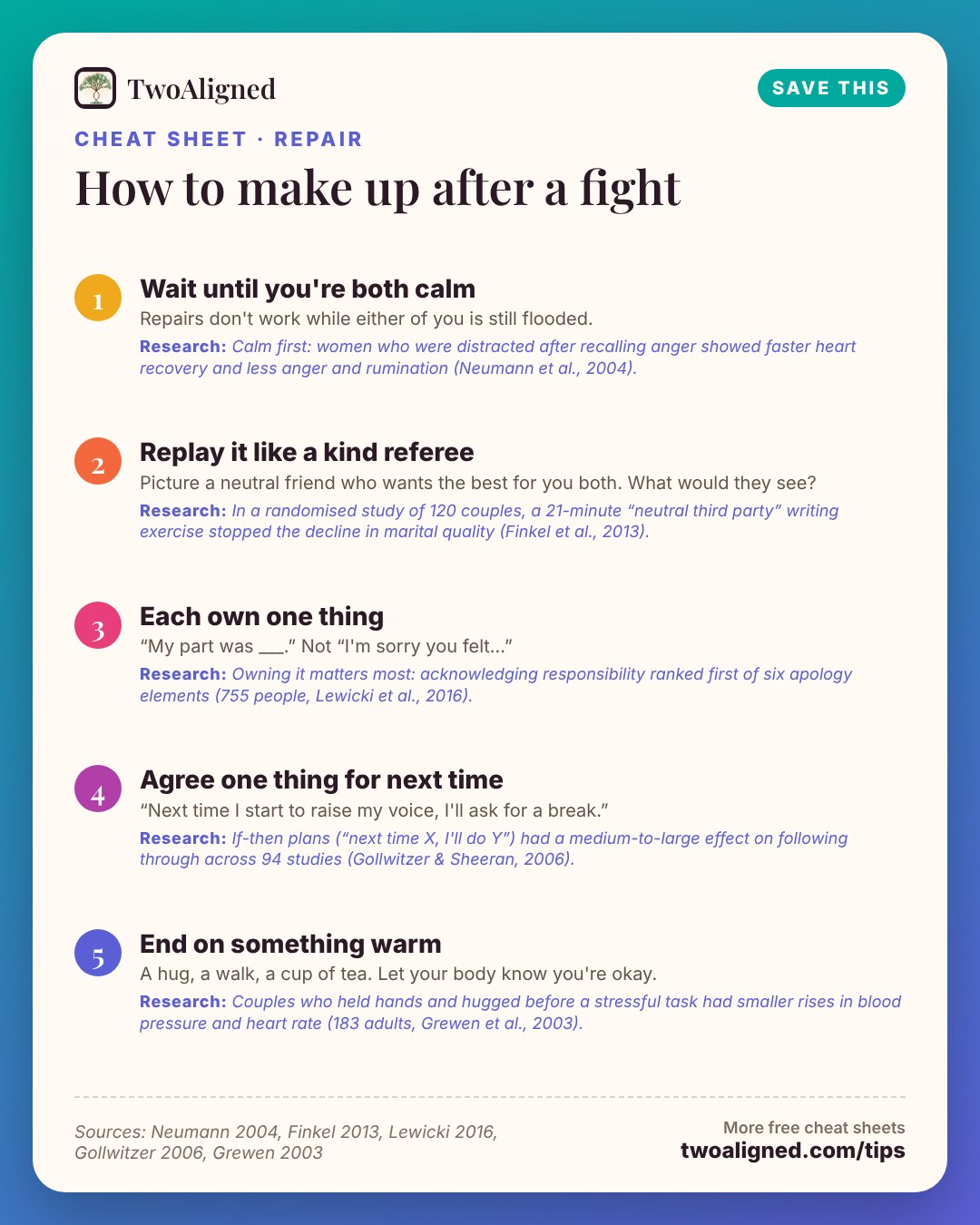
Wait until you're both calm
Repairs don't work while either of you is still flooded.
ResearchCalm first: women who were distracted after recalling anger showed faster heart recovery and less anger and rumination (Neumann et al., 2004).
- 2
Replay it like a kind referee
Picture a neutral friend who wants the best for you both. What would they see?
ResearchIn a randomised study of 120 couples, a 21-minute “neutral third party” writing exercise stopped the decline in marital quality (Finkel et al., 2013).
- 3
Each own one thing
“My part was ___.” Not “I'm sorry you felt…”
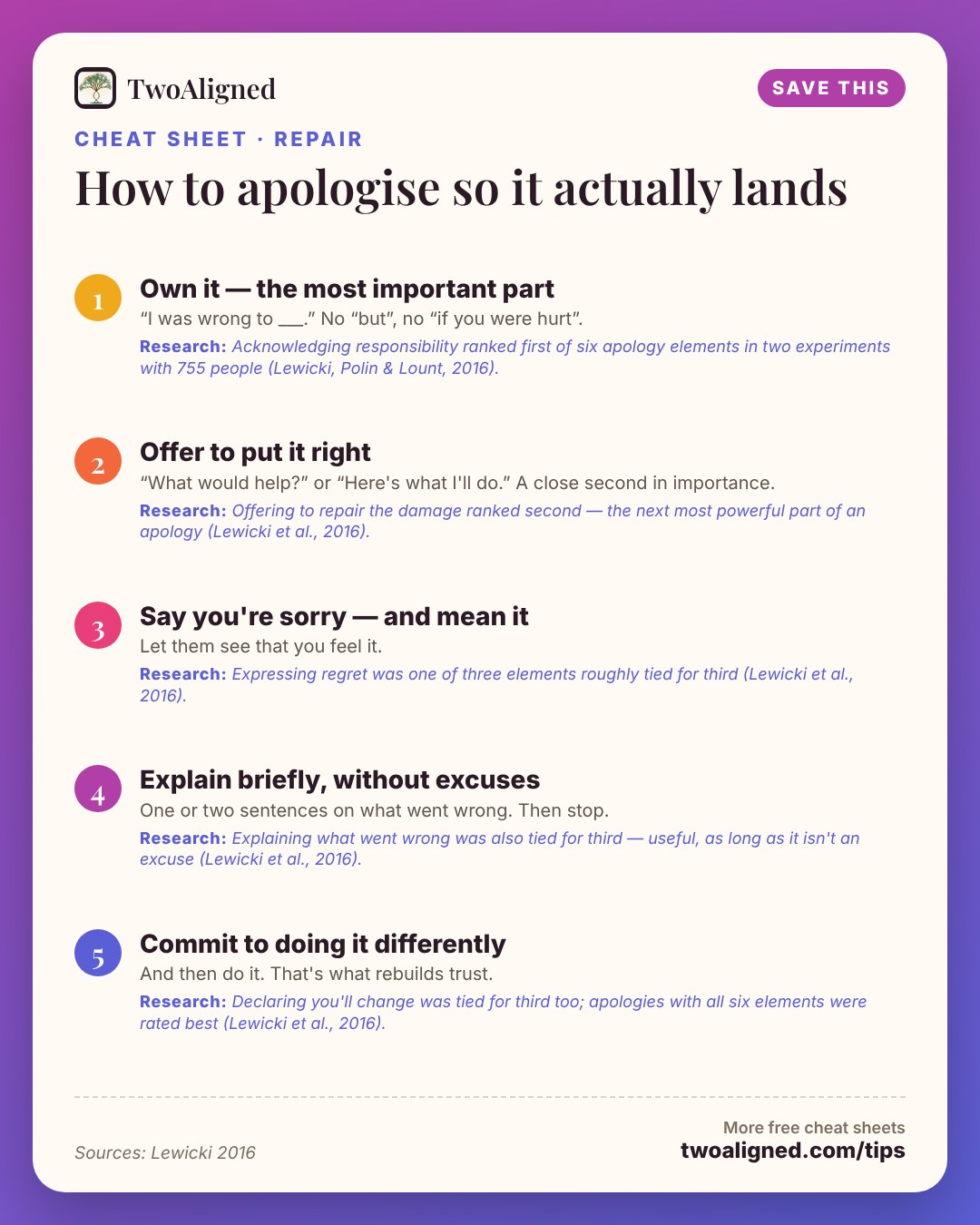
ResearchOwning it matters most: acknowledging responsibility ranked first of six apology elements (755 people, Lewicki et al., 2016).
- 4
Agree one thing for next time
“Next time I start to raise my voice, I'll ask for a break.”
ResearchIf-then plans (“next time X, I'll do Y”) had a medium-to-large effect on following through across 94 studies (Gollwitzer & Sheeran, 2006).
- 5
End on something warm
A hug, a walk, a cup of tea. Let your body know you're okay.
ResearchCouples who held hands and hugged before a stressful task had smaller rises in blood pressure and heart rate (183 adults, Grewen et al., 2003).
Why this works
In Eli Finkel's study of 120 married couples, spouses who spent just seven minutes, three times a year, writing about their conflicts from the view of a neutral third party who wants the best for both stopped the decline in marriage quality that the other couples showed.
Gottman's research also finds that successful repair attempts — small moves that soften things — are one of the clearest signs of a relationship that lasts.
Sources
- All the research behind TwoAligned
- Neumann et al. (2004), Health Psychology — distraction and cardiovascular recovery from anger
- Finkel et al. (2013), Psychological Science — conflict reappraisal preserves marital quality
- Lewicki, Polin & Lount (2016), Negotiation and Conflict Management Research — the six elements of an apology (ScienceDaily)
- Gollwitzer & Sheeran (2006), Advances in Experimental Social Psychology — implementation intentions meta-analysis (NCI summary)
- Grewen et al. (2003), Behavioral Medicine — warm partner contact and cardiovascular reactivity
- Greater Good (UC Berkeley) — a happier marriage in 21 minutes
- Finkel et al. (2013) — Psychological Science paper (PDF)
- Gottman Institute — physiological self-soothing
- Grewen et al. — warm partner contact and blood pressure (UNC)
These are the general steps. Want advice for your situation?
Take the free 2-minute quiz for a first read on what's really going on between you two.
Take the free quiz →