Cheat sheet · ADHD
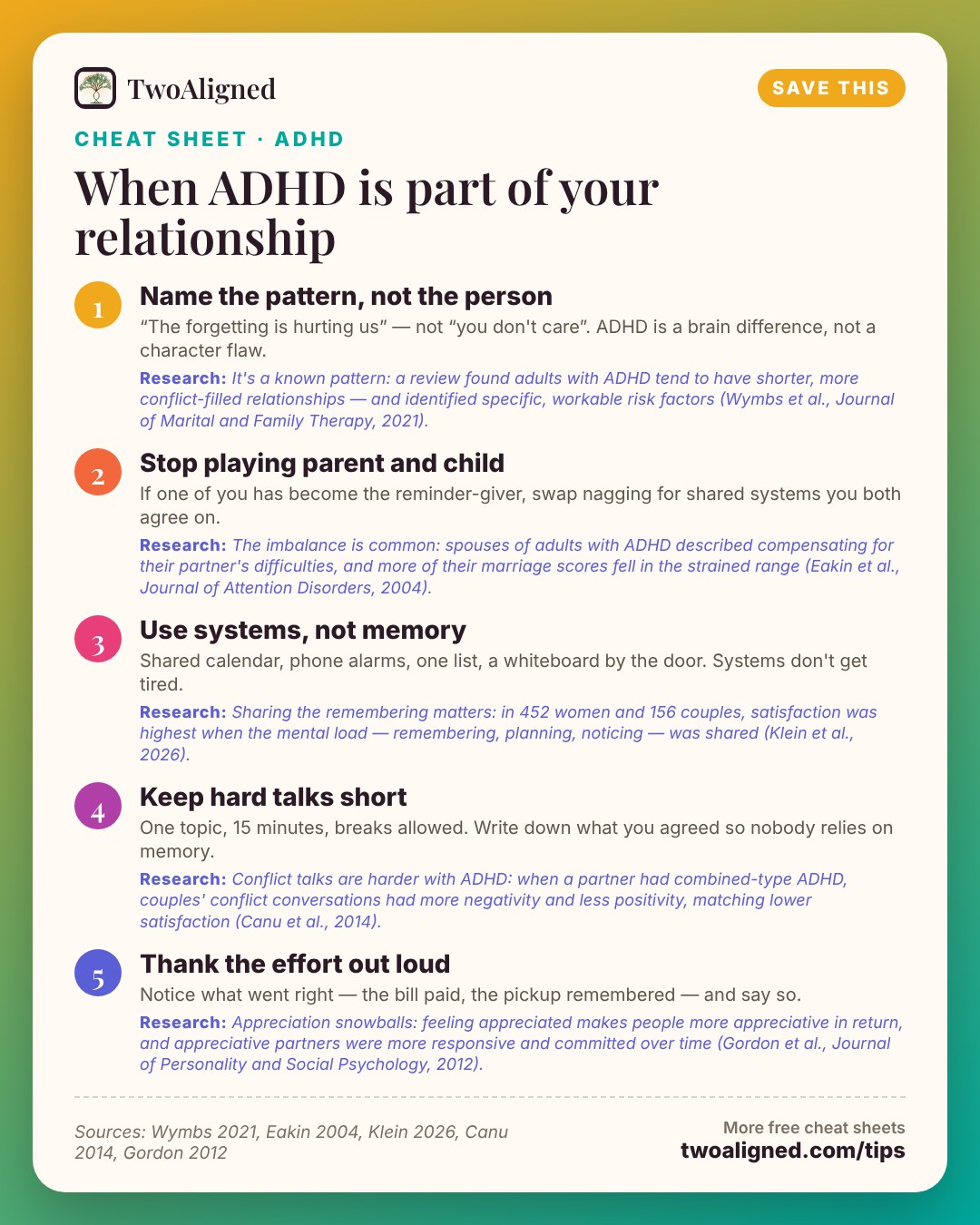
When ADHD is part of your relationship
Forgotten plans, half-finished jobs, impulsive words — and one partner slowly becoming the “manager”. ADHD is a known, workable pattern, not a lack of love. These steps help you both.
- 1
Name the pattern, not the person
“The forgetting is hurting us” — not “you don't care”. ADHD is a brain difference, not a character flaw.
ResearchIt's a known pattern: a review found adults with ADHD tend to have shorter, more conflict-filled relationships — and identified specific, workable risk factors (Wymbs et al., Journal of Marital and Family Therapy, 2021).
- 2
Stop playing parent and child
If one of you has become the reminder-giver, swap nagging for shared systems you both agree on.
ResearchThe imbalance is common: spouses of adults with ADHD described compensating for their partner's difficulties, and more of their marriage scores fell in the strained range (Eakin et al., Journal of Attention Disorders, 2004).
- 3
Use systems, not memory
Shared calendar, phone alarms, one list, a whiteboard by the door. Systems don't get tired.
ResearchSharing the remembering matters: in 452 women and 156 couples, satisfaction was highest when the mental load — remembering, planning, noticing — was shared (Klein et al., 2026).
- 4
Keep hard talks short
One topic, 15 minutes, breaks allowed. Write down what you agreed so nobody relies on memory.
ResearchConflict talks are harder with ADHD: when a partner had combined-type ADHD, couples' conflict conversations had more negativity and less positivity, matching lower satisfaction (Canu et al., 2014).
- 5
Thank the effort out loud
Notice what went right — the bill paid, the pickup remembered — and say so.
ResearchAppreciation snowballs: feeling appreciated makes people more appreciative in return, and appreciative partners were more responsive and committed over time (Gordon et al., Journal of Personality and Social Psychology, 2012).
Why this works
Research consistently finds that ADHD puts extra strain on romantic relationships — and that it is driven by specific risk factors that couples and clinicians can work on (Wymbs, Canu & Sacchetti, 2021). That's good news: specific problems have specific fixes.
If ADHD is suspected but has never been assessed, a proper assessment by a doctor is a sensible first step. Treatment for the person with ADHD and practical systems for the couple work best together.
Sources
- All the research behind TwoAligned
- Wymbs, Canu, Sacchetti & Ranson (2021), Journal of Marital and Family Therapy — adult ADHD and romantic relationships
- Eakin et al. (2004), Journal of Attention Disorders — marital and family functioning of adults with ADHD
- Klein et al. (2026), Personality and Social Psychology Bulletin — mental load and relationship satisfaction
- Canu et al. (2014), Journal of Marital and Family Therapy — ADHD type and couples' conflict resolution
- Gordon et al. (2012), Journal of Personality and Social Psychology — appreciation in relationships
These are the general steps. Want advice for your situation?
Take the free 2-minute quiz for a first read on what's really going on between you two.
Take the free quiz →