Cheat sheet · Mental health
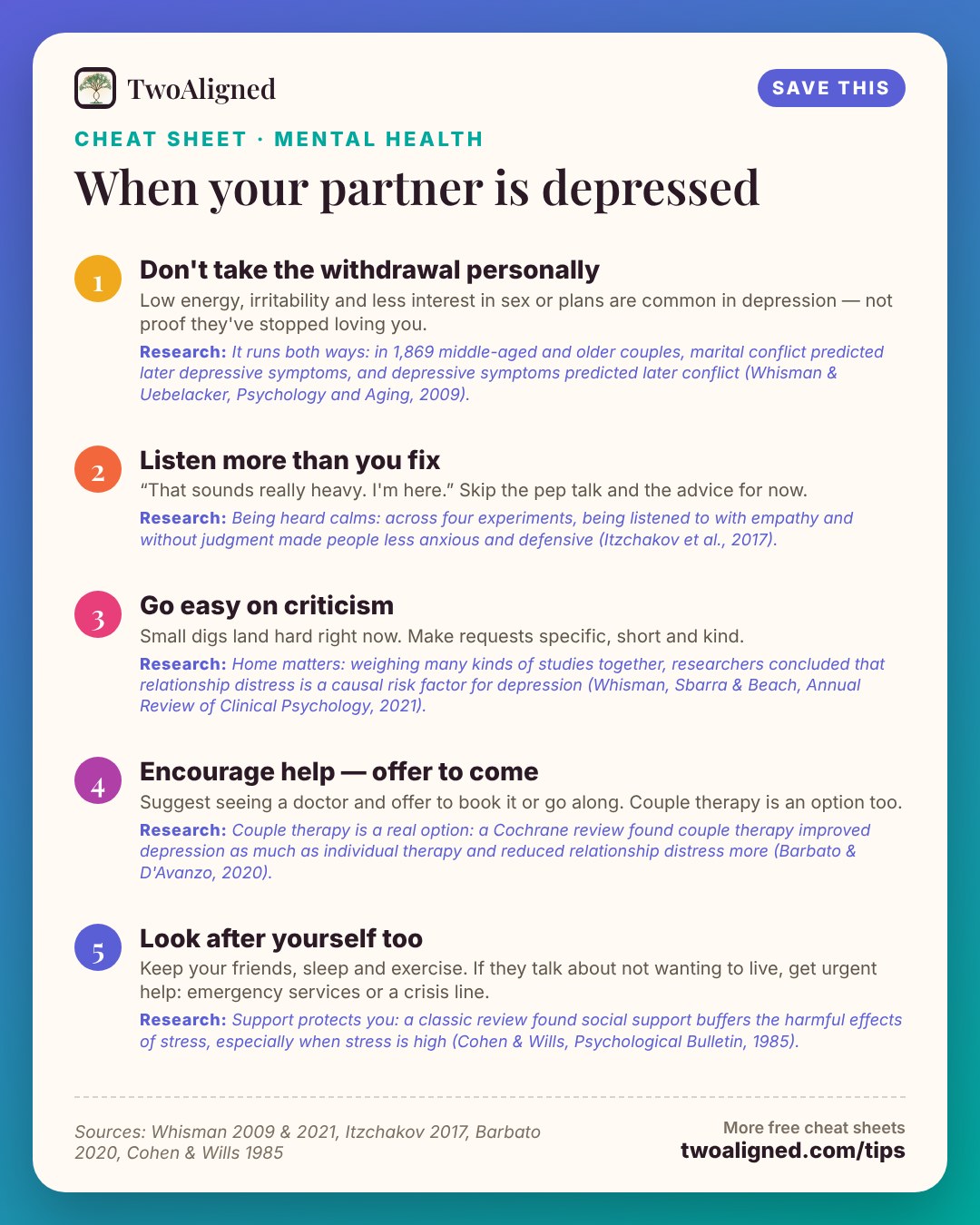
When your partner is depressed
Depression can look like not caring: withdrawn, irritable, flat, no interest in you or in plans. It's an illness, not a verdict on you or your relationship. These steps help you support them without losing yourself.
- 1
Don't take the withdrawal personally
Low energy, irritability and less interest in sex or plans are common in depression — not proof they've stopped loving you.
ResearchIt runs both ways: in 1,869 middle-aged and older couples, marital conflict predicted later depressive symptoms, and depressive symptoms predicted later conflict (Whisman & Uebelacker, Psychology and Aging, 2009).
- 2
Listen more than you fix
“That sounds really heavy. I'm here.” Skip the pep talk and the advice for now.
ResearchBeing heard calms: across four experiments, being listened to with empathy and without judgment made people less anxious and defensive (Itzchakov et al., 2017).
- 3
Go easy on criticism
Small digs land hard right now. Make requests specific, short and kind.
ResearchHome matters: weighing many kinds of studies together, researchers concluded that relationship distress is a causal risk factor for depression (Whisman, Sbarra & Beach, Annual Review of Clinical Psychology, 2021).
- 4
Encourage help — offer to come
Suggest seeing a doctor and offer to book it or go along. Couple therapy is an option too.
ResearchCouple therapy is a real option: a Cochrane review found couple therapy improved depression as much as individual therapy and reduced relationship distress more (Barbato & D'Avanzo, 2020).
- 5
Look after yourself too
Keep your friends, sleep and exercise. If they talk about not wanting to live, get urgent help: emergency services or a crisis line.
ResearchSupport protects you: a classic review found social support buffers the harmful effects of stress, especially when stress is high (Cohen & Wills, Psychological Bulletin, 1985).
Why this works
Depression and relationship strain feed each other. After weighing observational, genetic and treatment studies, researchers concluded that relationship distress is a causal risk factor for depression (Whisman et al., 2021) — so a calmer, kinder home is part of recovery, not a side issue.
You can't love someone out of depression, and you're not meant to. Professional help works, and couple therapy is an evidence-based option when the relationship is strained too (Barbato & D'Avanzo, Family Process, 2020).
Sources
- All the research behind TwoAligned
- Whisman & Uebelacker (2009), Psychology and Aging — marital discord and depressive symptoms
- Itzchakov, Kluger & Castro (2017), Personality and Social Psychology Bulletin — high-quality listening
- Whisman, Sbarra & Beach (2021), Annual Review of Clinical Psychology — intimate relationships and depression
- Barbato & D'Avanzo (2020), Family Process — couple therapy for depression (Cochrane)
- Cohen & Wills (1985), Psychological Bulletin — stress, social support and the buffering hypothesis
These are the general steps. Want advice for your situation?
Take the free 2-minute quiz for a first read on what's really going on between you two.
Take the free quiz →