Cheat sheet · Life changes
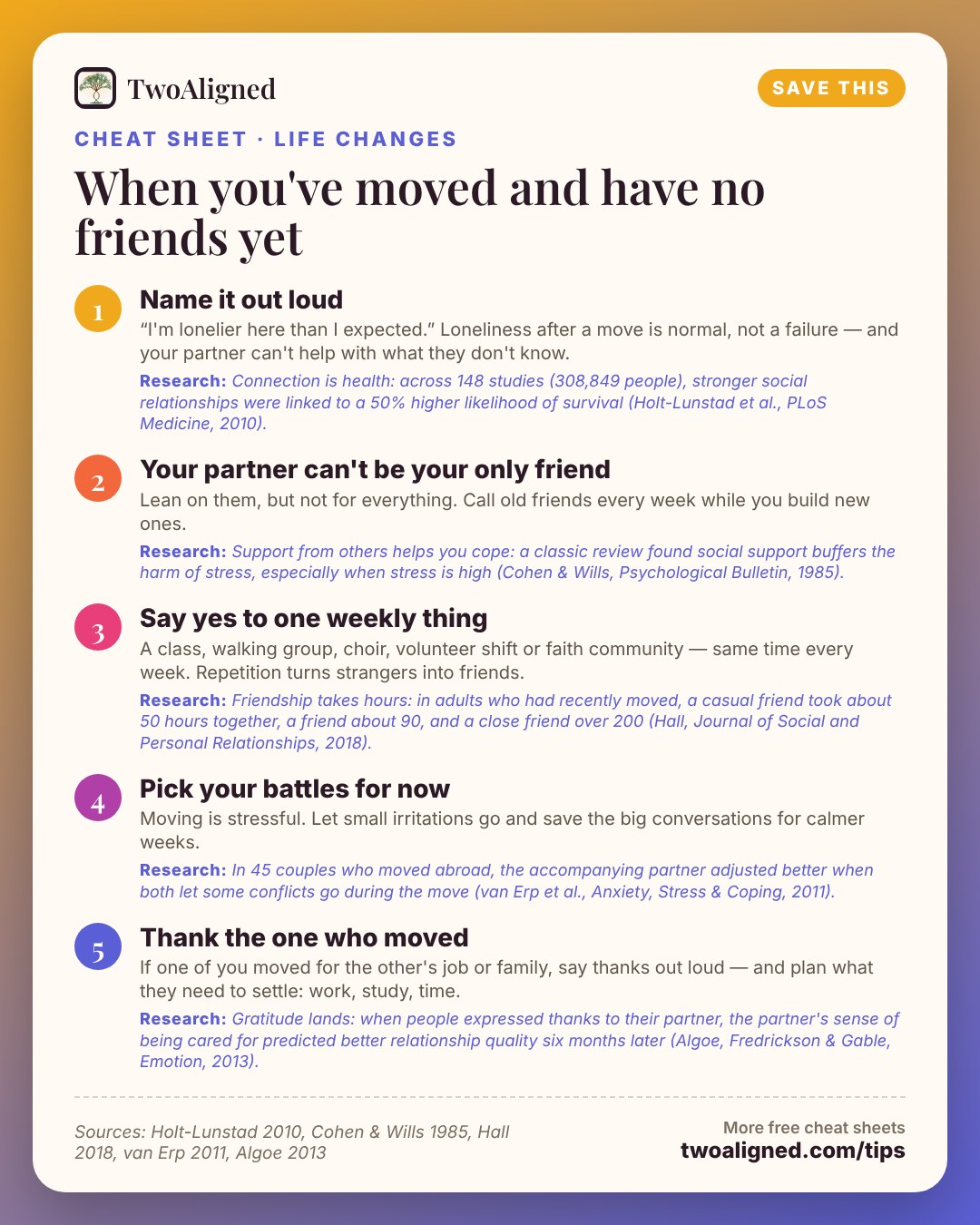
When you've moved and have no friends yet
A move for work or family can leave one of you starting from zero: no friends, no routine, and every emotional need landing on your partner. These steps help you build a life in the new place — and protect the relationship while you do.
- 1
Name it out loud
“I'm lonelier here than I expected.” Loneliness after a move is normal, not a failure — and your partner can't help with what they don't know.
ResearchConnection is health: across 148 studies (308,849 people), stronger social relationships were linked to a 50% higher likelihood of survival (Holt-Lunstad et al., PLoS Medicine, 2010).
- 2
Your partner can't be your only friend
Lean on them, but not for everything. Call old friends every week while you build new ones.
ResearchSupport from others helps you cope: a classic review found social support buffers the harm of stress, especially when stress is high (Cohen & Wills, Psychological Bulletin, 1985).
- 3
Say yes to one weekly thing
A class, walking group, choir, volunteer shift or faith community — same time every week. Repetition turns strangers into friends.
ResearchFriendship takes hours: in adults who had recently moved, a casual friend took about 50 hours together, a friend about 90, and a close friend over 200 (Hall, Journal of Social and Personal Relationships, 2018).
- 4
Pick your battles for now
Moving is stressful. Let small irritations go and save the big conversations for calmer weeks.
ResearchIn 45 couples who moved abroad, the accompanying partner adjusted better when both let some conflicts go during the move (van Erp et al., Anxiety, Stress & Coping, 2011).
- 5
Thank the one who moved
If one of you moved for the other's job or family, say thanks out loud — and plan what they need to settle: work, study, time.
ResearchGratitude lands: when people expressed thanks to their partner, the partner's sense of being cared for predicted better relationship quality six months later (Algoe, Fredrickson & Gable, Emotion, 2013).
Why this works
Friendship can't be rushed. Researcher Jeffrey Hall studied adults who had recently moved and found it took about 50 hours together to become casual friends, about 90 hours to become friends, and more than 200 hours to become close friends (Journal of Social and Personal Relationships, 2018). That's why a weekly commitment works better than one big night out.
Strong social ties matter for health as well as happiness: a meta-analysis of 148 studies linked stronger social relationships with a 50% higher likelihood of survival — comparable to well-known health risks (Holt-Lunstad et al., 2010).
Sources
- All the research behind TwoAligned
- Holt-Lunstad, Smith & Layton (2010), PLoS Medicine — social relationships and mortality risk meta-analysis
- Cohen & Wills (1985), Psychological Bulletin — stress, social support and the buffering hypothesis
- Hall (2018), Journal of Social and Personal Relationships — how many hours does it take to make a friend? (University of Kansas)
- van Erp et al. (2011), Anxiety, Stress & Coping — expatriate couples and conflict avoidance
- Algoe, Fredrickson & Gable (2013), Emotion — gratitude and relationship quality
These are the general steps. Want advice for your situation?
Take the free 2-minute quiz for a first read on what's really going on between you two.
Take the free quiz →