Cheat sheet · Alcohol
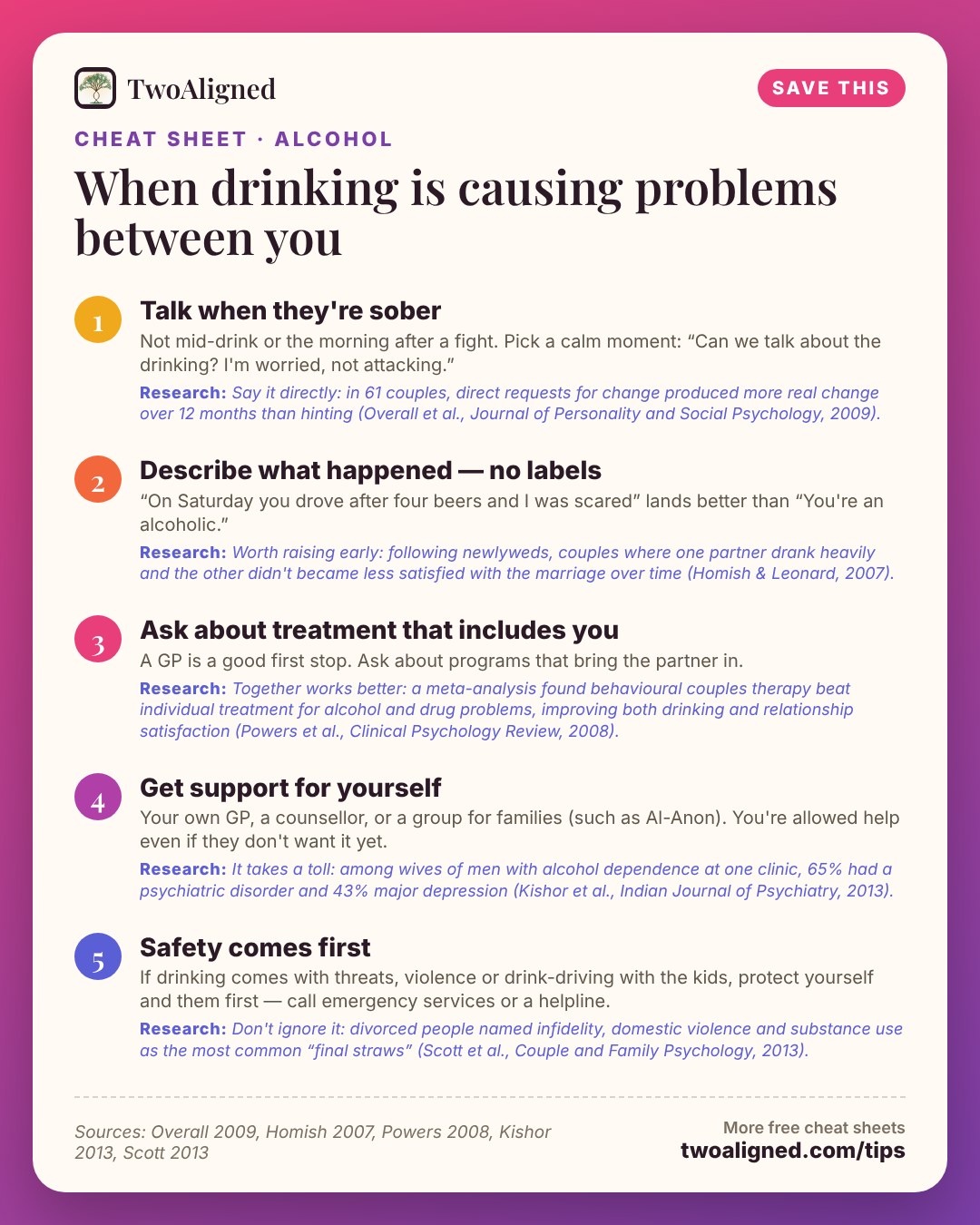
When drinking is causing problems between you
Heavy weekends, a bottle most nights, promises that don't hold — alcohol can quietly become the third person in a relationship. These steps help you raise it, protect yourself and find help that works.
- 1
Talk when they're sober
Not mid-drink or the morning after a fight. Pick a calm moment: “Can we talk about the drinking? I'm worried, not attacking.”
ResearchSay it directly: in 61 couples, direct requests for change produced more real change over 12 months than hinting (Overall et al., Journal of Personality and Social Psychology, 2009).
- 2
Describe what happened — no labels
“On Saturday you drove after four beers and I was scared” lands better than “You're an alcoholic.”
ResearchWorth raising early: following newlyweds, couples where one partner drank heavily and the other didn't became less satisfied with the marriage over time (Homish & Leonard, 2007).
- 3
Ask about treatment that includes you
A GP is a good first stop. Ask about programs that bring the partner in.
ResearchTogether works better: a meta-analysis found behavioural couples therapy beat individual treatment for alcohol and drug problems, improving both drinking and relationship satisfaction (Powers et al., Clinical Psychology Review, 2008).
- 4
Get support for yourself
Your own GP, a counsellor, or a group for families (such as Al-Anon). You're allowed help even if they don't want it yet.
ResearchIt takes a toll: among wives of men with alcohol dependence at one clinic, 65% had a psychiatric disorder and 43% major depression (Kishor et al., Indian Journal of Psychiatry, 2013).
- 5
Safety comes first
If drinking comes with threats, violence or drink-driving with the kids, protect yourself and them first — call emergency services or a helpline.
ResearchDon't ignore it: divorced people named infidelity, domestic violence and substance use as the most common “final straws” (Scott et al., Couple and Family Psychology, 2013).
Why this works
You can't control someone else's drinking, but you can change how you raise it and what support you get. Couple-based treatment has some of the strongest evidence: across studies, behavioural couples therapy outperformed individual treatment on drinking and on relationship satisfaction at follow-up (Powers, Vedel & Emmelkamp, 2008).
Living with a partner's heavy drinking is hard on your own health, so your support counts as much as theirs.
Sources
- All the research behind TwoAligned
- Overall et al. (2009), Journal of Personality and Social Psychology — regulating partners
- Homish & Leonard (2007), Journal of Consulting and Clinical Psychology — discrepant drinking and marital satisfaction
- Powers, Vedel & Emmelkamp (2008), Clinical Psychology Review — behavioural couples therapy meta-analysis
- Kishor, Pandit & Raguram (2013), Indian Journal of Psychiatry — spouses of men with alcohol dependence
- Scott, Rhoades, Stanley et al. (2013), Couple and Family Psychology — reasons for divorce
If you feel unsafe, or your partner hurts, threatens or controls you, this isn't a communication problem. Please contact local emergency services or a domestic-violence helpline.
These are the general steps. Want advice for your situation?
Take the free 2-minute quiz for a first read on what's really going on between you two.
Take the free quiz →