Cheat sheet · Communication
When you feel your partner isn't listening
Feeling unheard is one of the loneliest feelings in a relationship. Most of the time the fix isn't saying it louder — it's setting the conversation up so it can be heard.
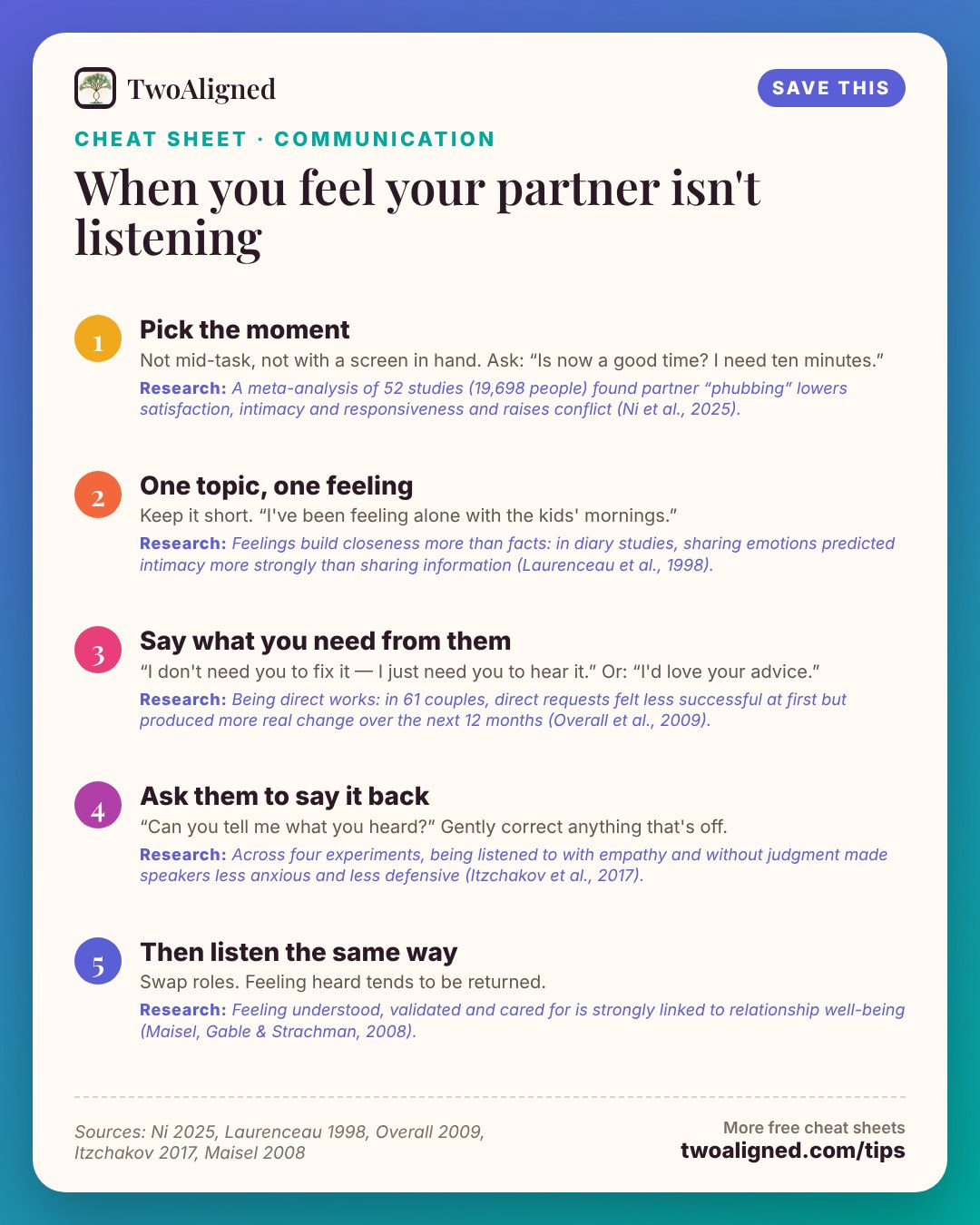
- 1
Pick the moment
Not mid-task, not with a screen in hand. Ask: “Is now a good time? I need ten minutes.”
ResearchA meta-analysis of 52 studies (19,698 people) found partner “phubbing” lowers satisfaction, intimacy and responsiveness and raises conflict (Ni et al., 2025).
- 2
One topic, one feeling
Keep it short. “I've been feeling alone with the kids' mornings.”
ResearchFeelings build closeness more than facts: in diary studies, sharing emotions predicted intimacy more strongly than sharing information (Laurenceau et al., 1998).
- 3
Say what you need from them
“I don't need you to fix it — I just need you to hear it.” Or: “I'd love your advice.”
ResearchBeing direct works: in 61 couples, direct requests felt less successful at first but produced more real change over the next 12 months (Overall et al., 2009).
- 4
Ask them to say it back
“Can you tell me what you heard?” Gently correct anything that's off.
ResearchAcross four experiments, being listened to with empathy and without judgment made speakers less anxious and less defensive (Itzchakov et al., 2017).
- 5
Then listen the same way
Swap roles. Feeling heard tends to be returned.
ResearchFeeling understood, validated and cared for is strongly linked to relationship well-being (Maisel, Gable & Strachman, 2008).
Why this works
Researchers call it perceived partner responsiveness: the sense that your partner understands you, values you and cares for you. Across many studies it is one of the strongest predictors of a satisfying relationship — often more important than how much you agree.
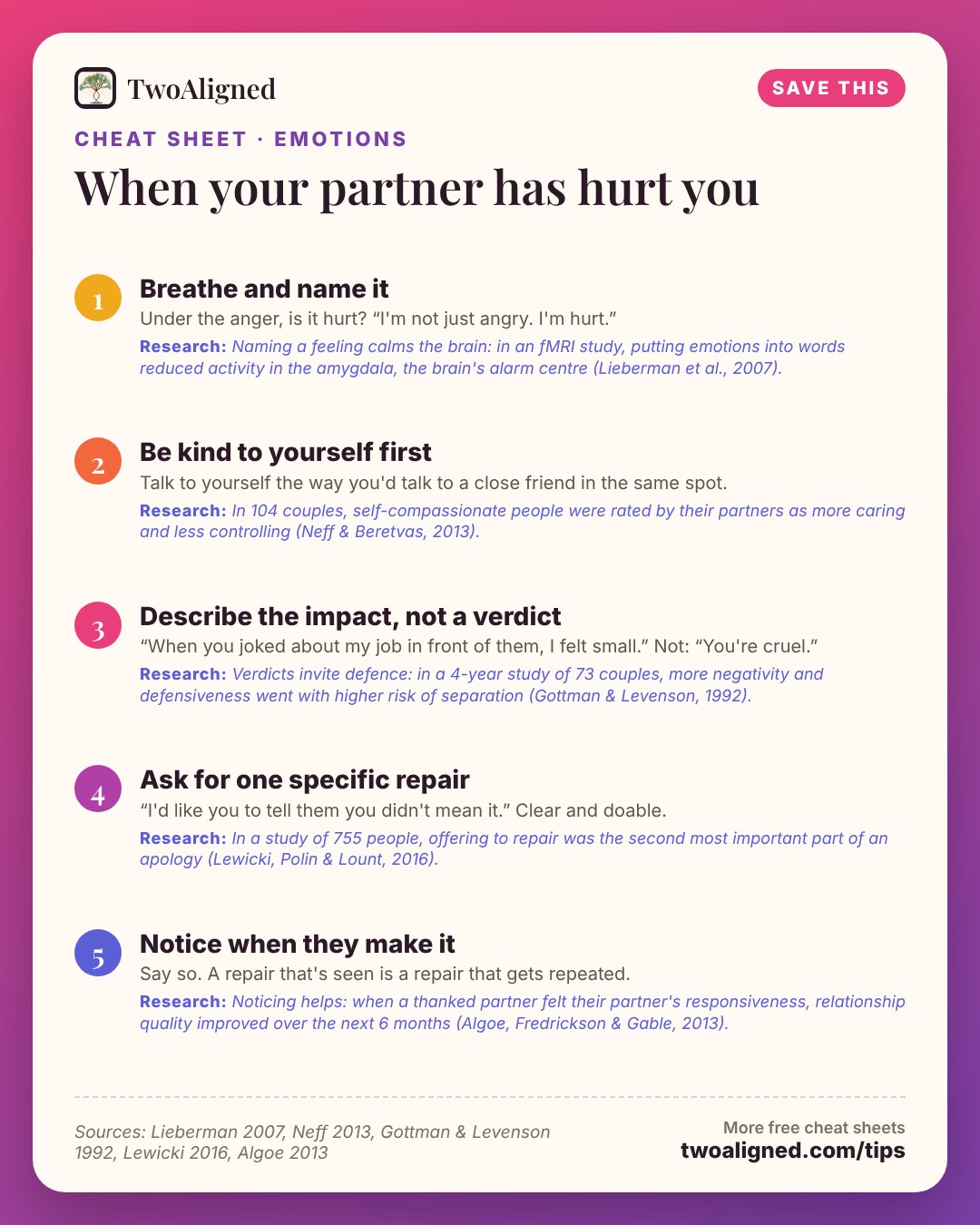
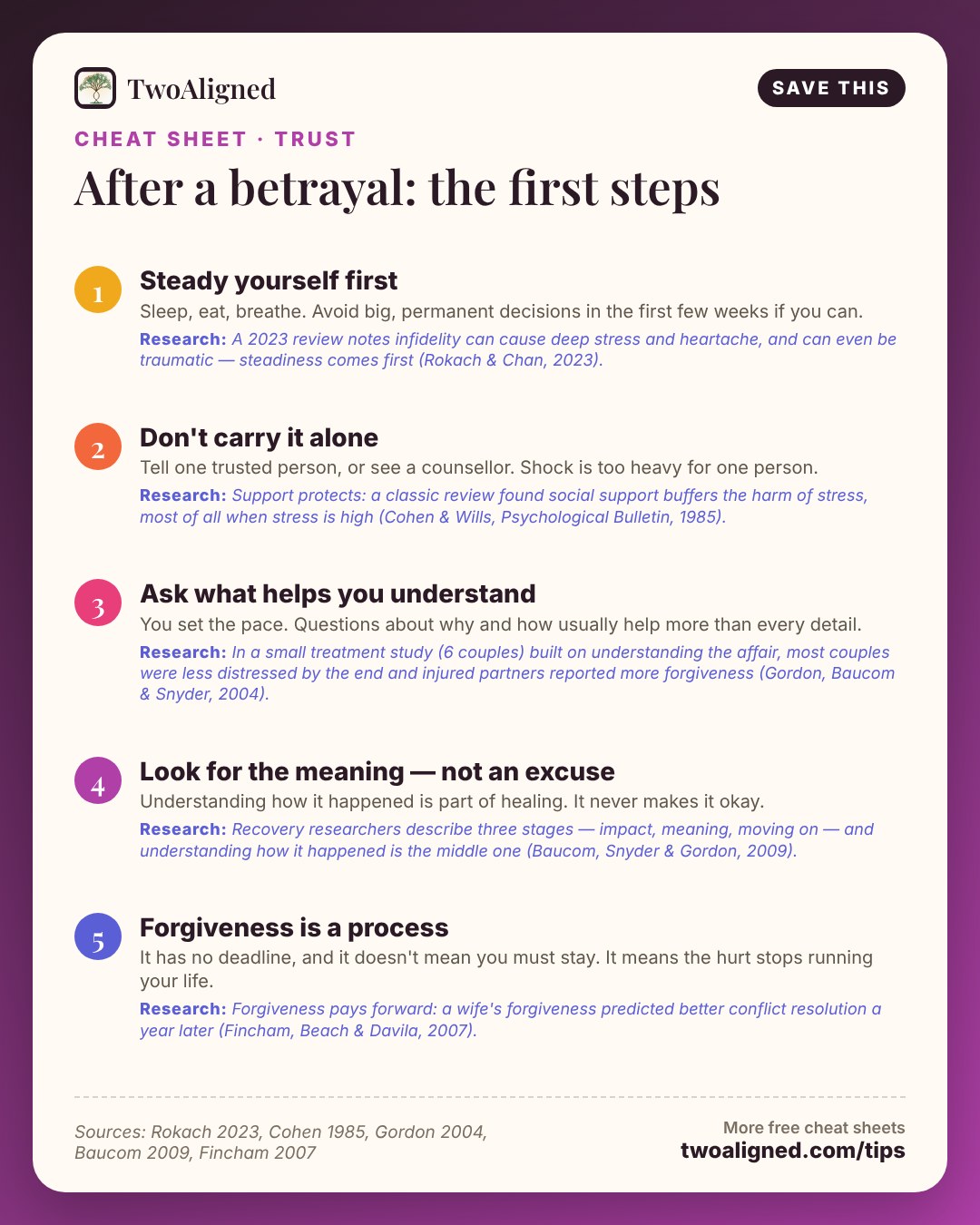
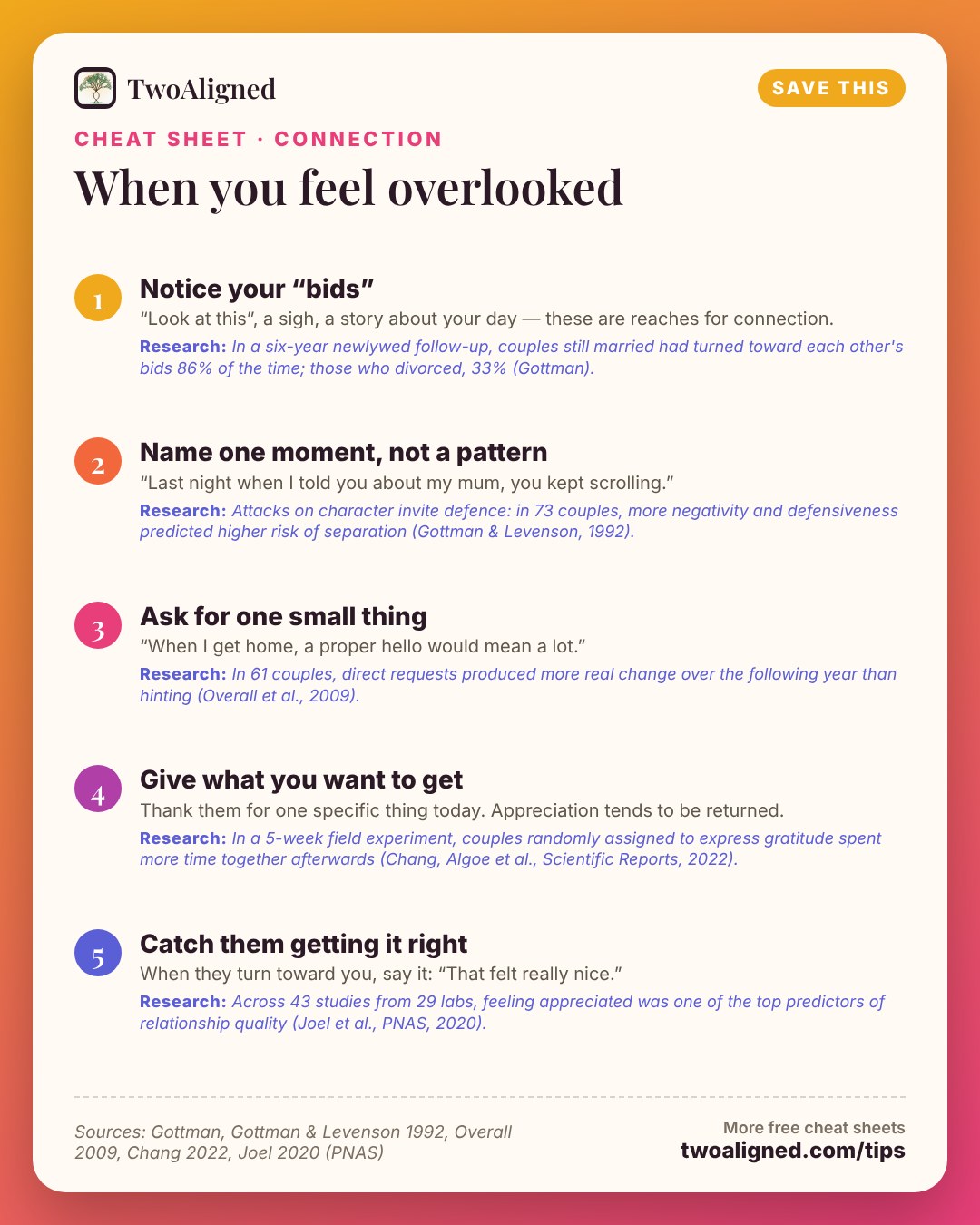
Telling your partner what kind of response you need (comfort or advice) makes it far easier for them to get it right.
Sources
- All the research behind TwoAligned
- Ni et al. (2025), Frontiers in Psychology — partner phubbing meta-analysis
- Laurenceau, Barrett & Pietromonaco (1998), Journal of Personality and Social Psychology — intimacy as an interpersonal process
- Overall et al. (2009), Journal of Personality and Social Psychology — regulating partners
- Itzchakov, Kluger & Castro (2017), Personality and Social Psychology Bulletin — high-quality listening
- Maisel, Gable & Strachman (2008), Personal Relationships — responsive behaviors
- McDaniel & Coyne — 'technoference' in couples (ZME Science summary)
- Lieberman et al. (2007) — putting feelings into words calms the amygdala (ScienceDaily)
- Overall et al. — direct, positive requests and lasting change (Psychology Today)
These are the general steps. Want advice for your situation?
Take the free 2-minute quiz for a first read on what's really going on between you two.
Take the free quiz →