Cheat sheet · Trust
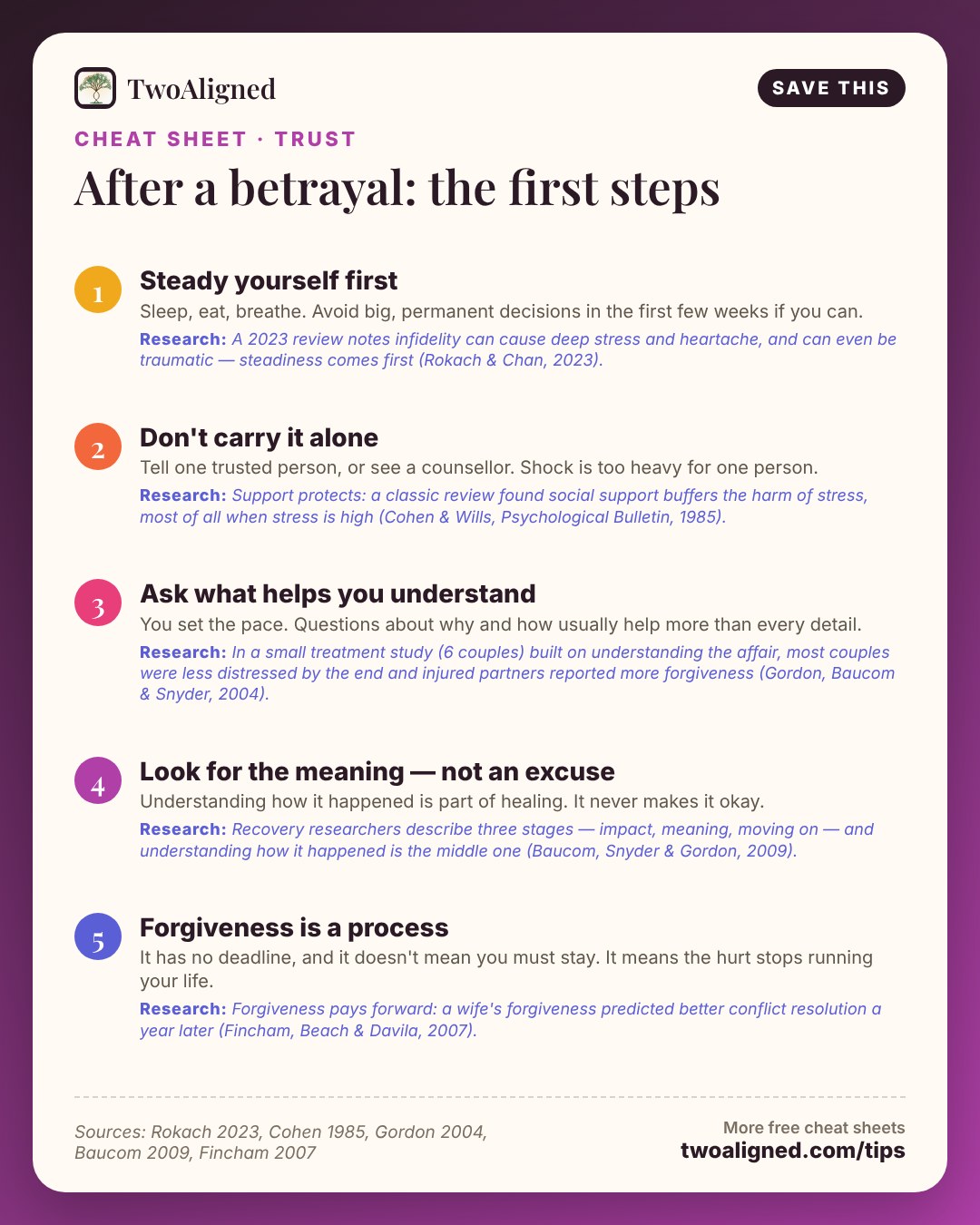
After a betrayal: the first steps
Discovering a betrayal turns your world upside down. You don't have to decide everything now. Recovery happens in stages — and the first stage is simply getting steady.
- 1
Steady yourself first
Sleep, eat, breathe. Avoid big, permanent decisions in the first few weeks if you can.
ResearchA 2023 review notes infidelity can cause deep stress and heartache, and can even be traumatic — steadiness comes first (Rokach & Chan, 2023).
- 2
Don't carry it alone
Tell one trusted person, or see a counsellor. Shock is too heavy for one person.
ResearchSupport protects: a classic review found social support buffers the harm of stress, most of all when stress is high (Cohen & Wills, Psychological Bulletin, 1985).
- 3
Ask what helps you understand
You set the pace. Questions about why and how usually help more than every detail.
ResearchIn a small treatment study (6 couples) built on understanding the affair, most couples were less distressed by the end and injured partners reported more forgiveness (Gordon, Baucom & Snyder, 2004).
- 4
Look for the meaning — not an excuse
Understanding how it happened is part of healing. It never makes it okay.
ResearchRecovery researchers describe three stages — impact, meaning, moving on — and understanding how it happened is the middle one (Baucom, Snyder & Gordon, 2009).
- 5
Forgiveness is a process
It has no deadline, and it doesn't mean you must stay. It means the hurt stops running your life.
ResearchForgiveness pays forward: a wife's forgiveness predicted better conflict resolution a year later (Fincham, Beach & Davila, 2007).
Why this works
Leading affair-recovery researchers Donald Baucom, Douglas Snyder and Kristina Coop Gordon describe three stages: impact (getting through the shock), meaning (understanding how it happened) and moving on (forgiveness, whether or not the couple stays together).
Their approach is built on forgiveness as a process — not forgetting, and not excusing.
Sources
- All the research behind TwoAligned
- Rokach & Chan (2023), International Journal of Environmental Research and Public Health — love and infidelity review
- Cohen & Wills (1985), Psychological Bulletin — stress, social support and the buffering hypothesis
- Gordon, Baucom & Snyder (2004), Journal of Marital and Family Therapy — recovery from affairs
- Baucom, Snyder & Gordon (2009), Helping Couples Get Past the Affair — Guilford Press
- Fincham, Beach & Davila (2007), Journal of Family Psychology — forgiveness and conflict resolution
- Social buffering — Cohen & Wills (1985) stress-buffering hypothesis
- Fincham, Beach & Davila (2007) — forgiveness and later conflict resolution
If you feel unsafe, or your partner hurts, threatens or controls you, this isn't a communication problem. Please contact local emergency services or a domestic-violence helpline.
These are the general steps. Want advice for your situation?
Take the free 2-minute quiz for a first read on what's really going on between you two.
Take the free quiz →