Cheat sheet · Connection
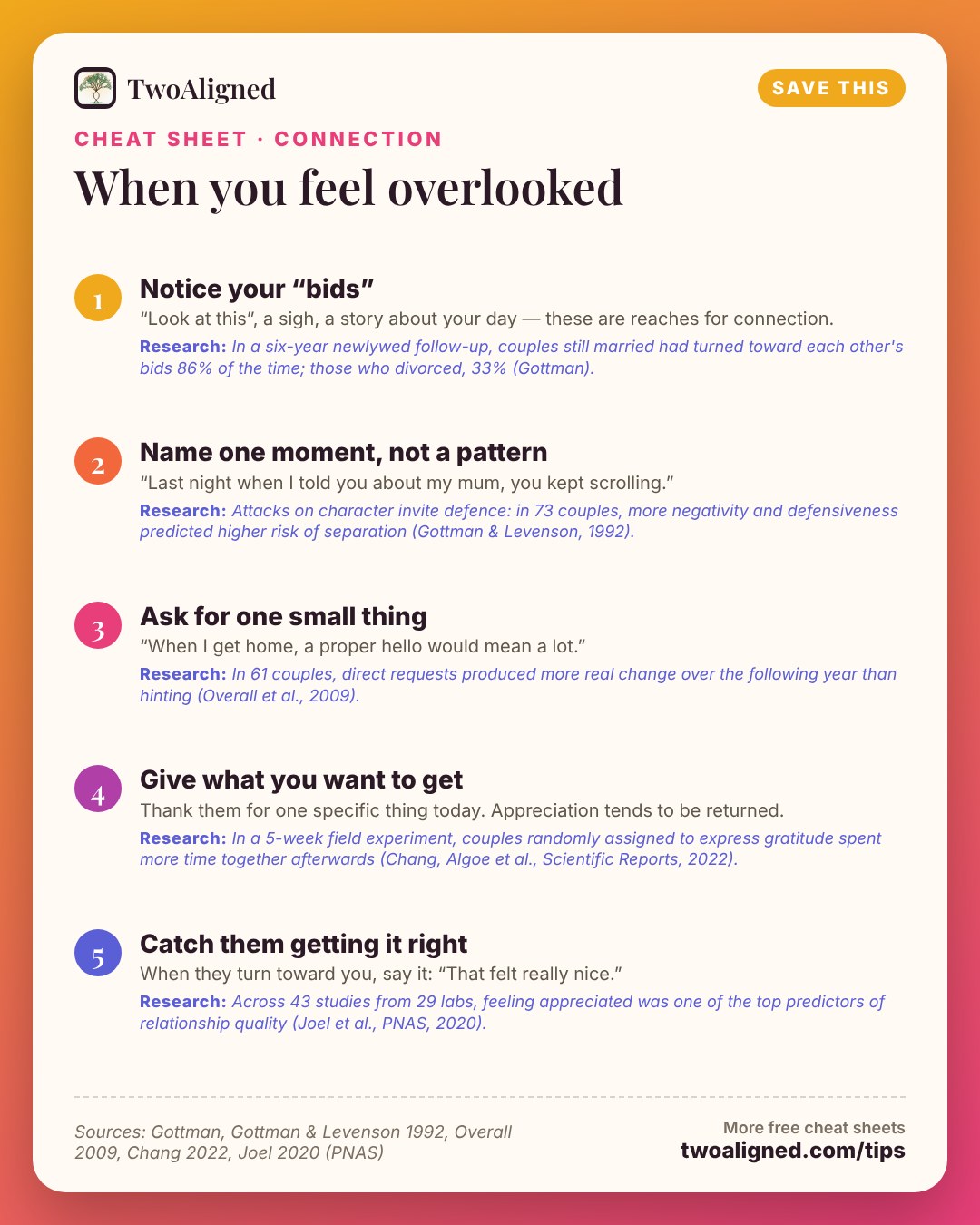
When you feel overlooked
Feeling invisible rarely comes from one big moment. It's a hundred small moments where you reached out and nobody reached back. Here's how to turn that around.
- 1
Notice your “bids”
“Look at this”, a sigh, a story about your day — these are reaches for connection.
ResearchIn a six-year newlywed follow-up, couples still married had turned toward each other's bids 86% of the time; those who divorced, 33% (Gottman).
- 2
Name one moment, not a pattern
“Last night when I told you about my mum, you kept scrolling.”
ResearchAttacks on character invite defence: in 73 couples, more negativity and defensiveness predicted higher risk of separation (Gottman & Levenson, 1992).
- 3
Ask for one small thing
“When I get home, a proper hello would mean a lot.”
ResearchIn 61 couples, direct requests produced more real change over the following year than hinting (Overall et al., 2009).
- 4
Give what you want to get
Thank them for one specific thing today. Appreciation tends to be returned.
ResearchIn a 5-week field experiment, couples randomly assigned to express gratitude spent more time together afterwards (Chang, Algoe et al., Scientific Reports, 2022).
- 5
Catch them getting it right
When they turn toward you, say it: “That felt really nice.”
ResearchAcross 43 studies from 29 labs, feeling appreciated was one of the top predictors of relationship quality (Joel et al., PNAS, 2020).
Why this works
Dr John Gottman followed newlyweds for six years. Couples who were still married had turned toward each other's small bids for attention 86% of the time; couples who divorced averaged 33%.
A 2012 study in the Journal of Personality and Social Psychology found that feeling appreciated makes people more appreciative in return — and more appreciative partners were more responsive and more committed over time (Gordon, Impett and colleagues).
Sources
- All the research behind TwoAligned
- Gottman Institute — turning toward bids (newlywed follow-up)
- Gottman & Levenson (1992), Journal of Personality and Social Psychology — marital processes predictive of dissolution
- Overall et al. (2009), Journal of Personality and Social Psychology — regulating partners
- Chang, Algoe et al. (2022), Scientific Reports — gratitude expression field experiment
- Joel et al. (2020), Proceedings of the National Academy of Sciences — 43 longitudinal couples studies
- Gordon et al. (2012) — gratitude promotes relationship maintenance
- Gottman Institute — the Four Horsemen (criticism, contempt)
- Overall et al. — direct, positive requests and lasting change (Psychology Today)
- Gottman Institute — the 5:1 magic ratio
These are the general steps. Want advice for your situation?
Take the free 2-minute quiz for a first read on what's really going on between you two.
Take the free quiz →