Cheat sheet · Emotions
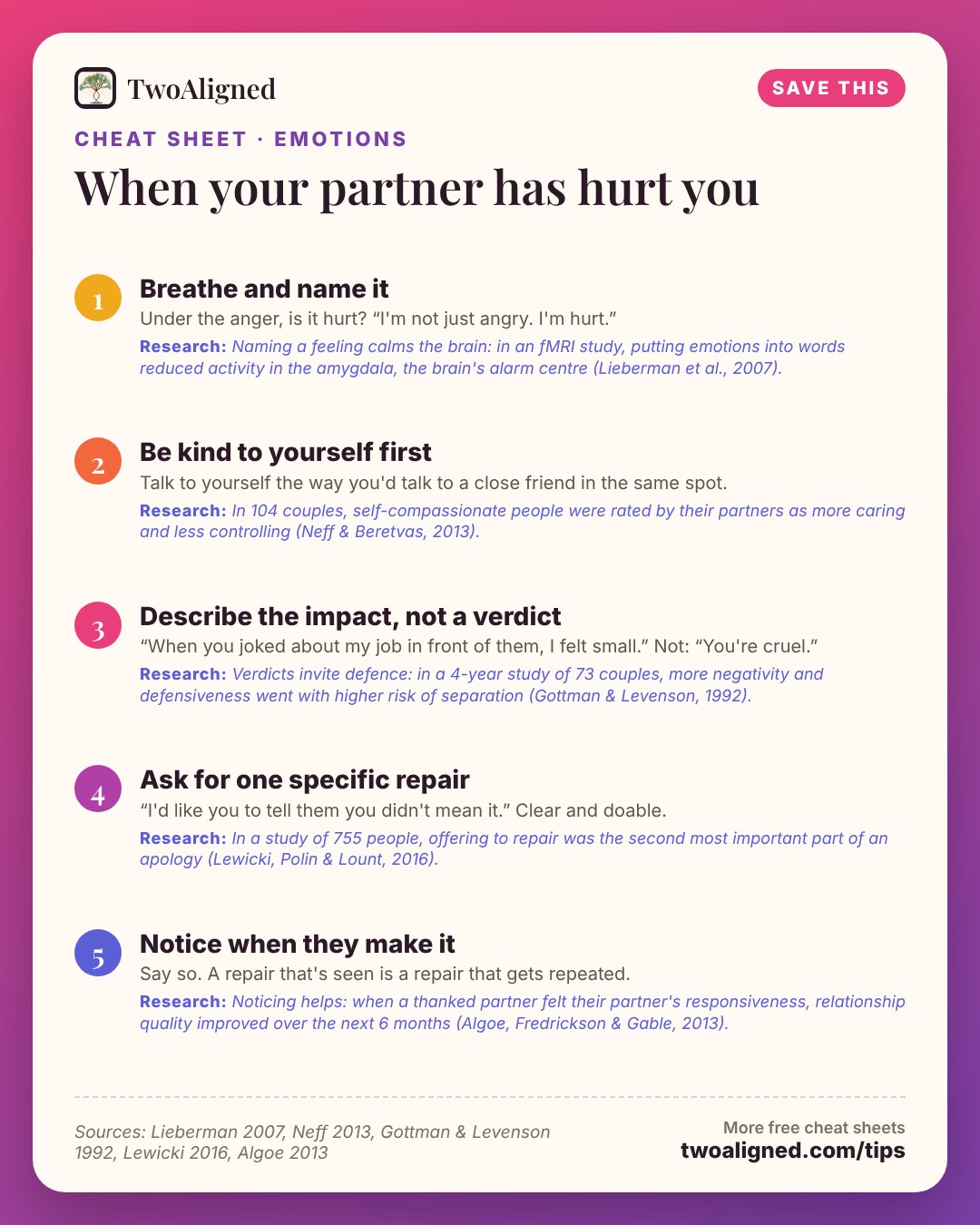
When your partner has hurt you
Hurt can come out as anger, silence or sarcasm — and then the real wound never gets talked about. These steps help you name it and ask for repair.
- 1
Breathe and name it
Under the anger, is it hurt? “I'm not just angry. I'm hurt.”
ResearchNaming a feeling calms the brain: in an fMRI study, putting emotions into words reduced activity in the amygdala, the brain's alarm centre (Lieberman et al., 2007).
- 2
Be kind to yourself first
Talk to yourself the way you'd talk to a close friend in the same spot.
ResearchIn 104 couples, self-compassionate people were rated by their partners as more caring and less controlling (Neff & Beretvas, 2013).
- 3
Describe the impact, not a verdict
“When you joked about my job in front of them, I felt small.” Not: “You're cruel.”
ResearchVerdicts invite defence: in a 4-year study of 73 couples, more negativity and defensiveness went with higher risk of separation (Gottman & Levenson, 1992).
- 4
Ask for one specific repair
“I'd like you to tell them you didn't mean it.” Clear and doable.
ResearchIn a study of 755 people, offering to repair was the second most important part of an apology (Lewicki, Polin & Lount, 2016).
- 5
Notice when they make it
Say so. A repair that's seen is a repair that gets repeated.
ResearchNoticing helps: when a thanked partner felt their partner's responsiveness, relationship quality improved over the next 6 months (Algoe, Fredrickson & Gable, 2013).
Why this works
In a study of 104 couples, people with more self-compassion were described by their partners as more caring, accepting and less controlling — and their partners were more satisfied (Neff & Beretvas). Being kind to yourself isn't soft; it helps you respond better.
Apology research finds the parts that matter most are owning the mistake and offering to repair it — so asking for a specific repair gives your partner the clearest path back.
Sources
- All the research behind TwoAligned
- Lieberman et al. (2007), Psychological Science — affect labeling and the amygdala
- Neff & Beretvas (2013), Self and Identity — self-compassion in romantic relationships (UT Austin summary)
- Gottman & Levenson (1992), Journal of Personality and Social Psychology — marital processes predictive of dissolution
- Lewicki, Polin & Lount (2016), Negotiation and Conflict Management Research — the six elements of an apology (ScienceDaily)
- Algoe, Fredrickson & Gable (2013), Emotion — the social functions of gratitude
- Lieberman et al. (2007) — putting feelings into words calms the amygdala (ScienceDaily)
- Gottman Institute — the Four Horsemen (criticism, contempt)
- Gottman Institute — the 5:1 magic ratio
If you feel unsafe, or your partner hurts, threatens or controls you, this isn't a communication problem. Please contact local emergency services or a domestic-violence helpline.
These are the general steps. Want advice for your situation?
Take the free 2-minute quiz for a first read on what's really going on between you two.
Take the free quiz →