Cheat sheet · Conflict
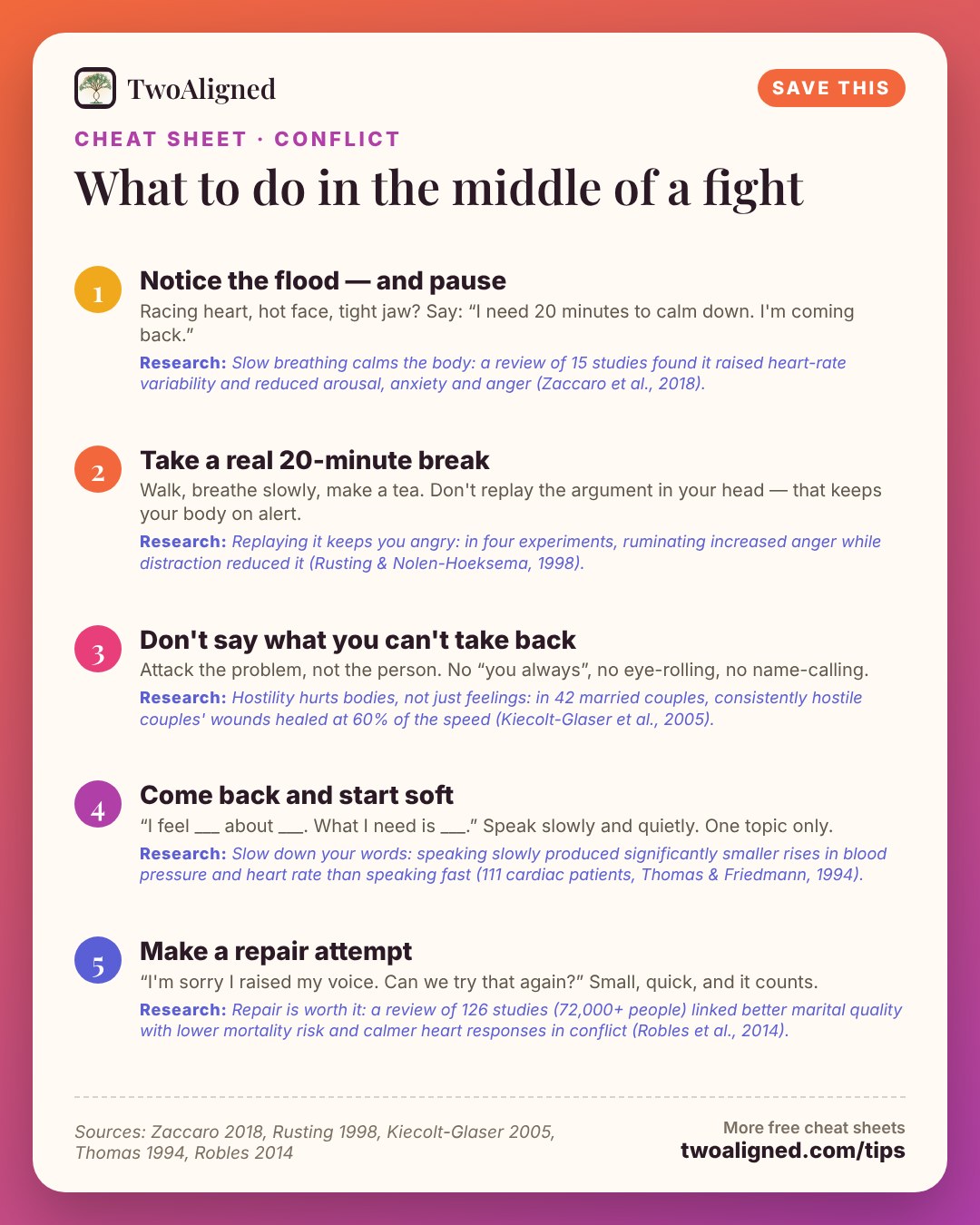
What to do in the middle of a fight
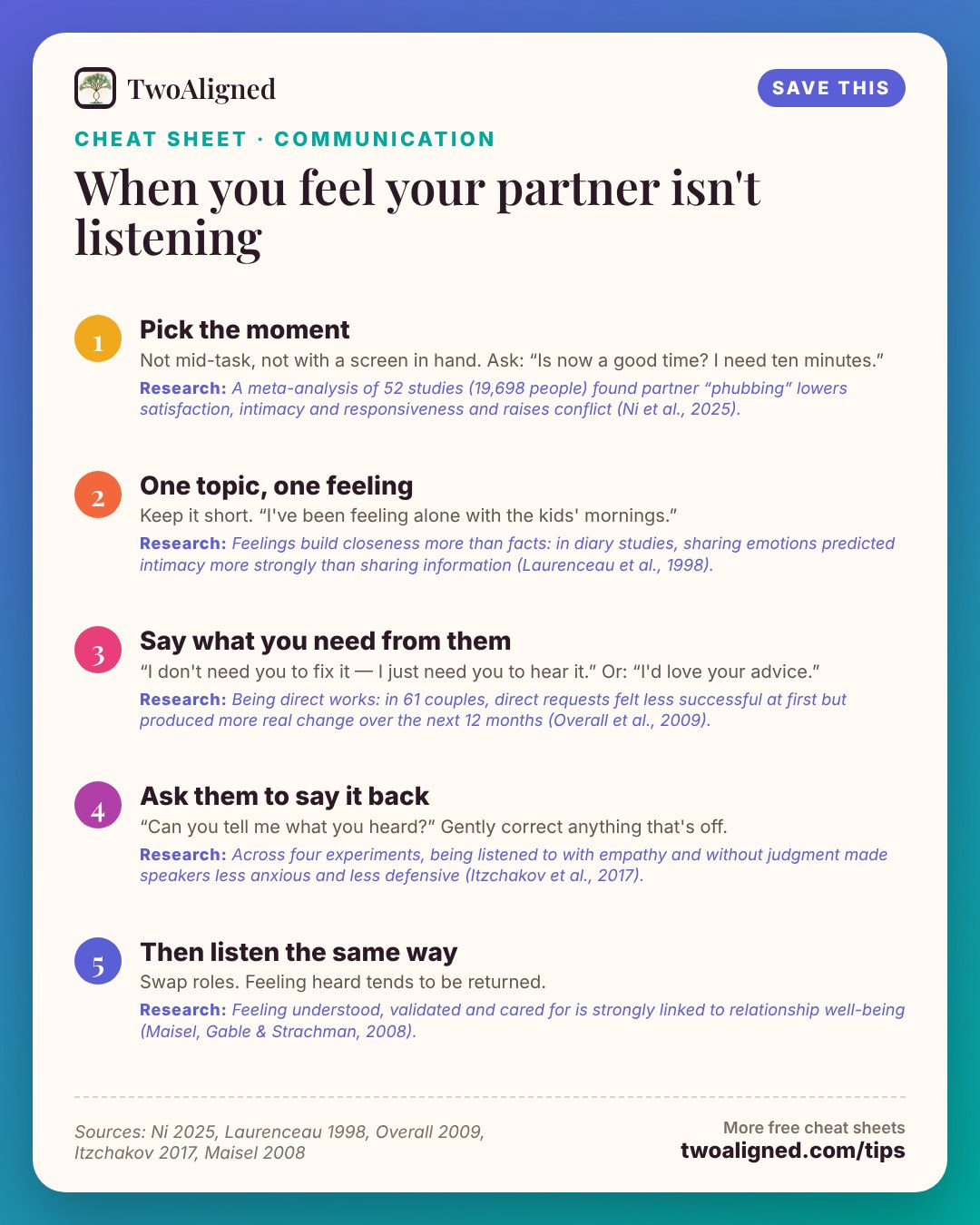
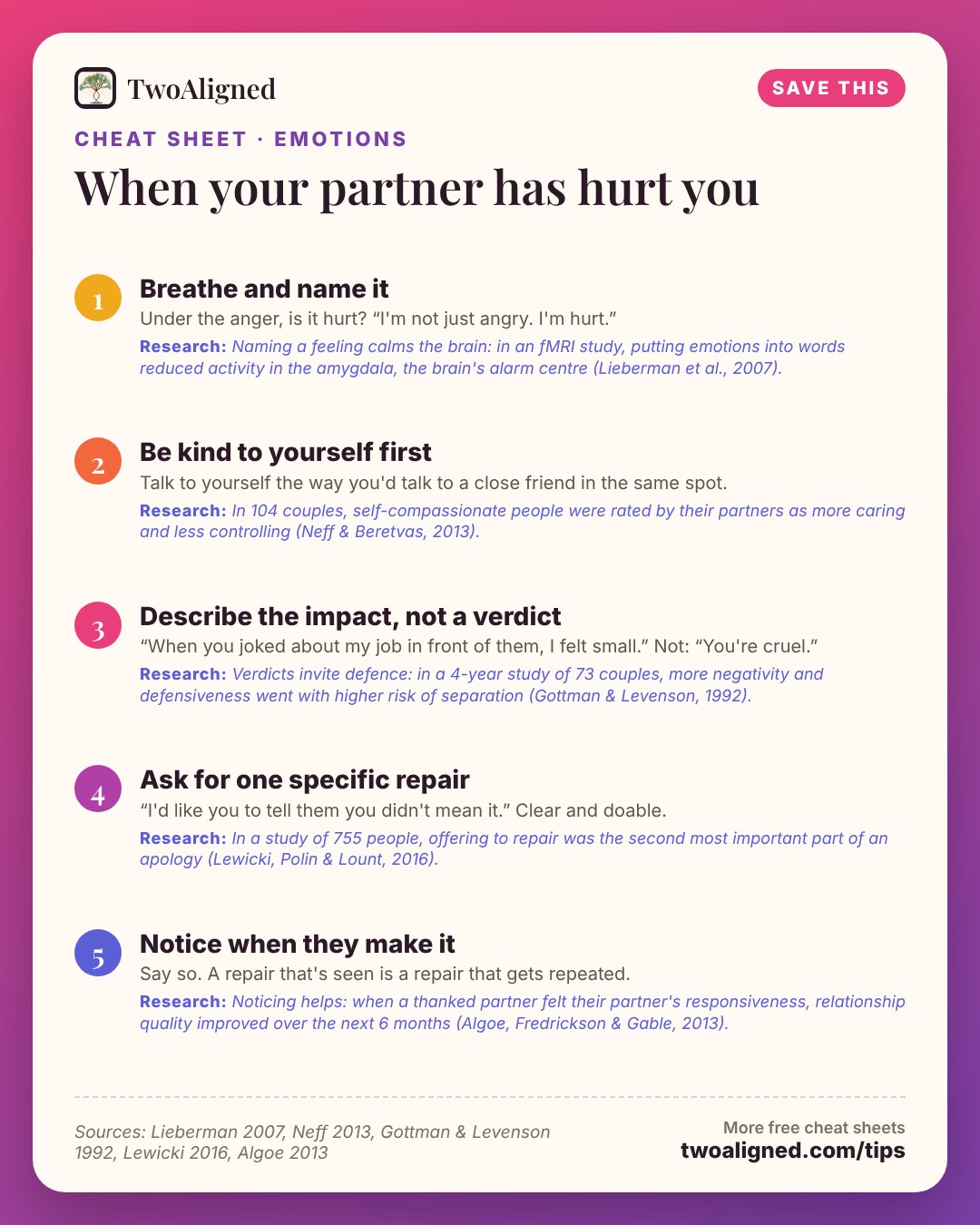
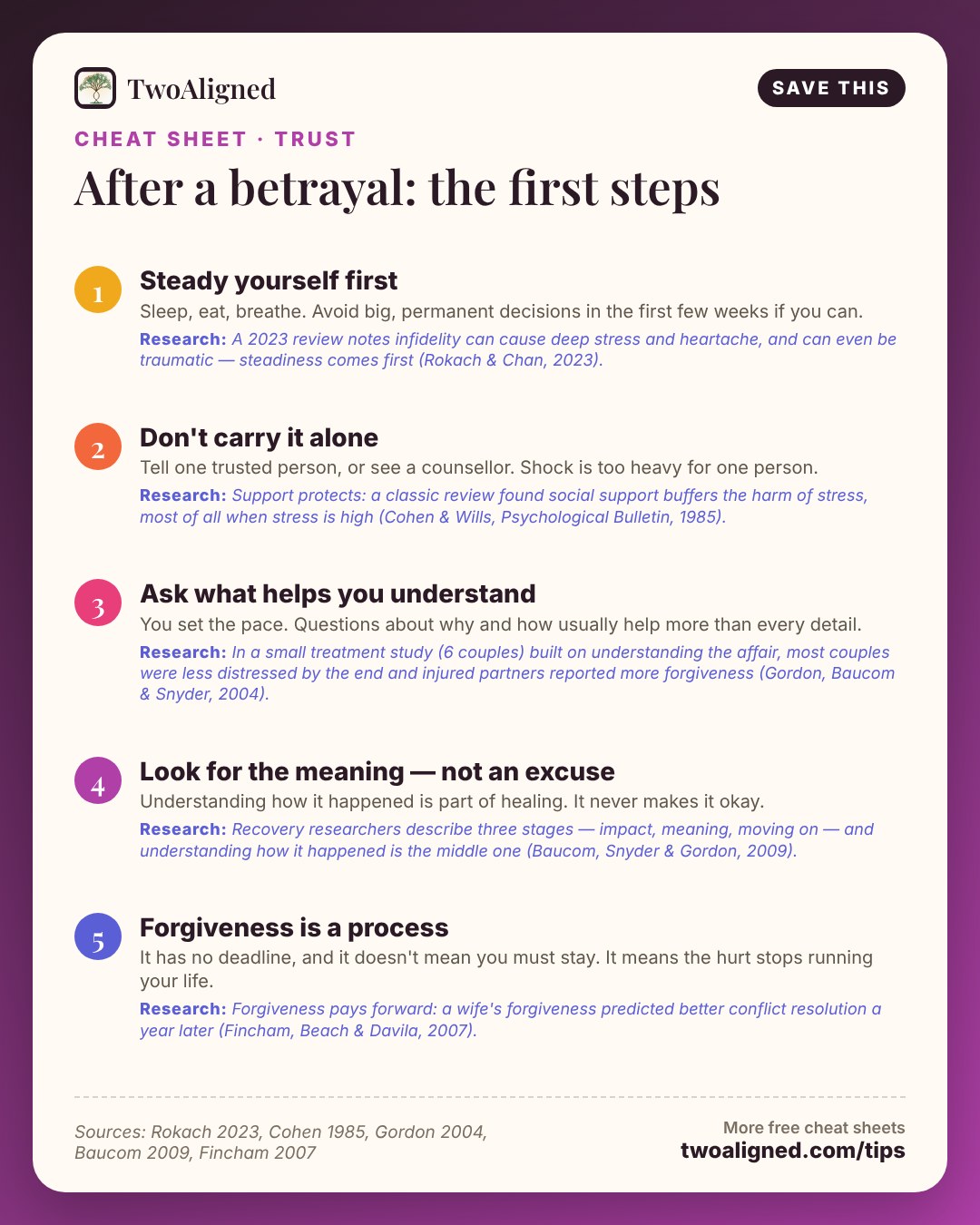
When a fight heats up, your body takes over and good words stop coming out. These five steps get you out of the spiral without walking away from the problem.
- 1
Notice the flood — and pause
Racing heart, hot face, tight jaw? Say: “I need 20 minutes to calm down. I'm coming back.”
ResearchSlow breathing calms the body: a review of 15 studies found it raised heart-rate variability and reduced arousal, anxiety and anger (Zaccaro et al., 2018).
- 2
Take a real 20-minute break
Walk, breathe slowly, make a tea. Don't replay the argument in your head — that keeps your body on alert.
ResearchReplaying it keeps you angry: in four experiments, ruminating increased anger while distraction reduced it (Rusting & Nolen-Hoeksema, 1998).
- 3
Don't say what you can't take back
Attack the problem, not the person. No “you always”, no eye-rolling, no name-calling.
ResearchHostility hurts bodies, not just feelings: in 42 married couples, consistently hostile couples' wounds healed at 60% of the speed (Kiecolt-Glaser et al., 2005).
- 4
Come back and start soft
“I feel ___ about ___. What I need is ___.” Speak slowly and quietly. One topic only.
ResearchSlow down your words: speaking slowly produced significantly smaller rises in blood pressure and heart rate than speaking fast (111 cardiac patients, Thomas & Friedmann, 1994).
- 5
Make a repair attempt
“I'm sorry I raised my voice. Can we try that again?” Small, quick, and it counts.
ResearchRepair is worth it: a review of 126 studies (72,000+ people) linked better marital quality with lower mortality risk and calmer heart responses in conflict (Robles et al., 2014).
Why this works
When your heart rate climbs above about 100 beats a minute, Dr John Gottman's research found people largely stop being able to take in what their partner is saying — and it takes around 20 minutes for the body to settle. That's why the break works and why it has to be real.
In a study of 124 newlywed couples, how the first three minutes of a disagreement went predicted which couples later divorced (Carrère & Gottman, 1999). A soft start changes the whole conversation.
Sources
- All the research behind TwoAligned
- Zaccaro et al. (2018), Frontiers in Human Neuroscience — systematic review of slow breathing
- Rusting & Nolen-Hoeksema (1998), Journal of Personality and Social Psychology — rumination vs. distraction
- Kiecolt-Glaser et al. (2005), Archives of General Psychiatry — hostile marital interactions and wound healing
- Thomas & Friedmann (1994), Journal of Cardiovascular Nursing — rate of speech and heart rate
- Robles et al. (2014), Psychological Bulletin — marital quality and health meta-analysis
- Gottman Institute — physiological self-soothing
- University of Washington — the first three minutes predict divorce (1999)
- Zaccaro et al. (2018) — systematic review of slow breathing, Frontiers in Human Neuroscience
- Bushman (2002) — venting, rumination and distraction (University of Notre Dame summary)
- Gottman Institute — the Four Horsemen (criticism, contempt)
- Gottman Institute — repair attempts
These are the general steps. Want advice for your situation?
Take the free 2-minute quiz for a first read on what's really going on between you two.
Take the free quiz →