Cheat sheet · Family
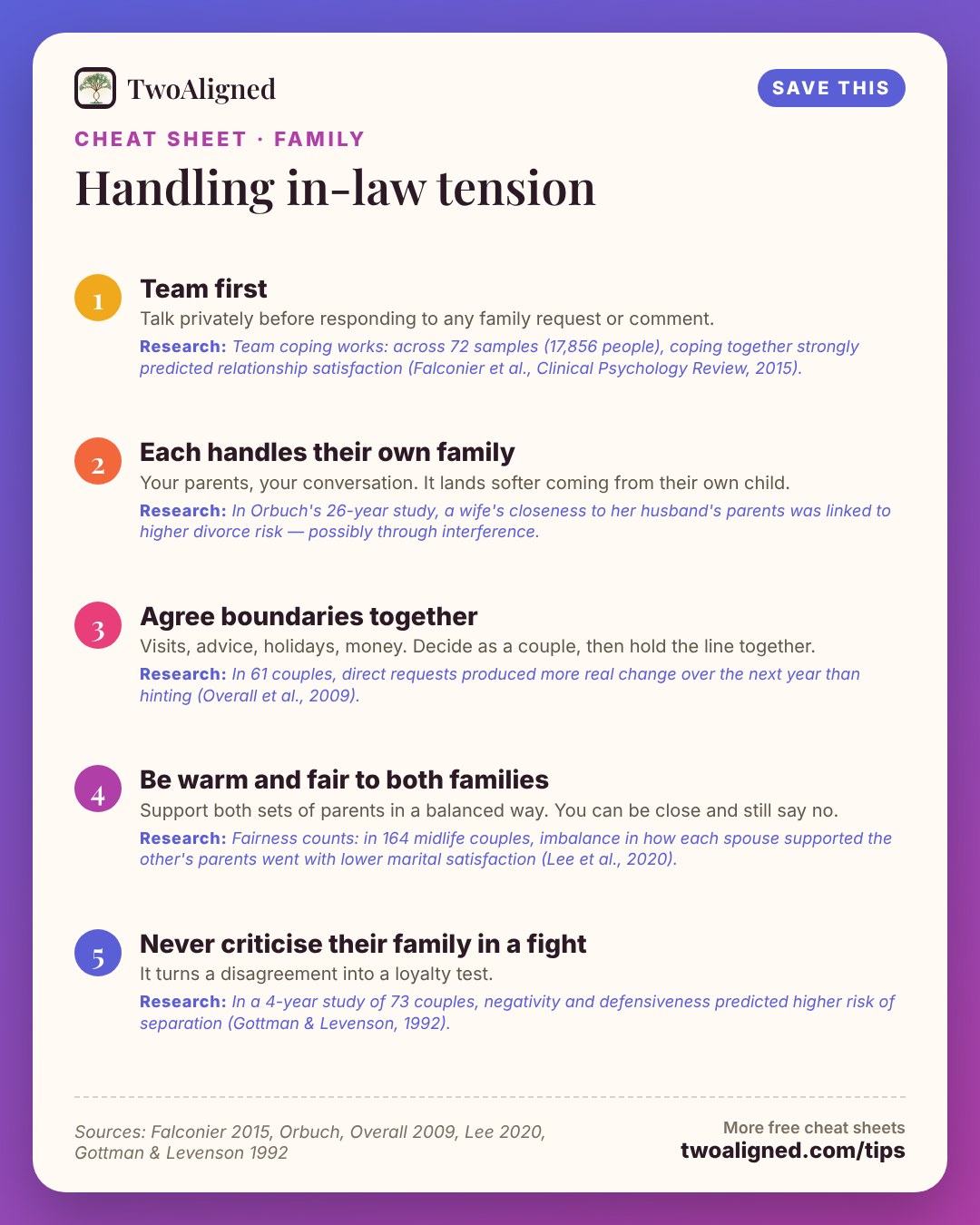
Handling in-law tension
You married a person — and a family came with them. Handled well, in-laws are a support. Handled badly, they become a wedge. These steps keep you on the same team.
- 1
Team first
Talk privately before responding to any family request or comment.
ResearchTeam coping works: across 72 samples (17,856 people), coping together strongly predicted relationship satisfaction (Falconier et al., Clinical Psychology Review, 2015).
- 2
Each handles their own family
Your parents, your conversation. It lands softer coming from their own child.
ResearchIn Orbuch's 26-year study, a wife's closeness to her husband's parents was linked to higher divorce risk — possibly through interference.
- 3
Agree boundaries together
Visits, advice, holidays, money. Decide as a couple, then hold the line together.
ResearchIn 61 couples, direct requests produced more real change over the next year than hinting (Overall et al., 2009).
- 4
Be warm and fair to both families
Support both sets of parents in a balanced way. You can be close and still say no.
ResearchFairness counts: in 164 midlife couples, imbalance in how each spouse supported the other's parents went with lower marital satisfaction (Lee et al., 2020).
- 5
Never criticise their family in a fight
It turns a disagreement into a loyalty test.
ResearchIn a 4-year study of 73 couples, negativity and defensiveness predicted higher risk of separation (Gottman & Levenson, 1992).
Why this works
Terri Orbuch's 26-year study of married couples found that when husbands were close to their wife's parents, the couple's divorce risk was about 20% lower. When wives were close to their husband's parents, it was about 20% higher — possibly because that closeness can come with interference. Closeness helps; boundaries keep it healthy.
Sources
- All the research behind TwoAligned
- Falconier et al. (2015), Clinical Psychology Review — dyadic coping meta-analysis
- Orbuch — 26-year study of married couples and in-laws (WBUR)
- Overall et al. (2009), Journal of Personality and Social Psychology — regulating partners
- Lee, Kim, Cichy & Fingerman (2020), Gerontology — support for parents-in-law and marital satisfaction
- Gottman & Levenson (1992), Journal of Personality and Social Psychology — marital processes predictive of dissolution
- Falconier et al. (2015) — dyadic coping meta-analysis
- Overall et al. — direct, positive requests and lasting change (Psychology Today)
- Gottman Institute — the Four Horsemen (criticism, contempt)
These are the general steps. Want advice for your situation?
Take the free 2-minute quiz for a first read on what's really going on between you two.
Take the free quiz →