Cheat sheet · Intimacy
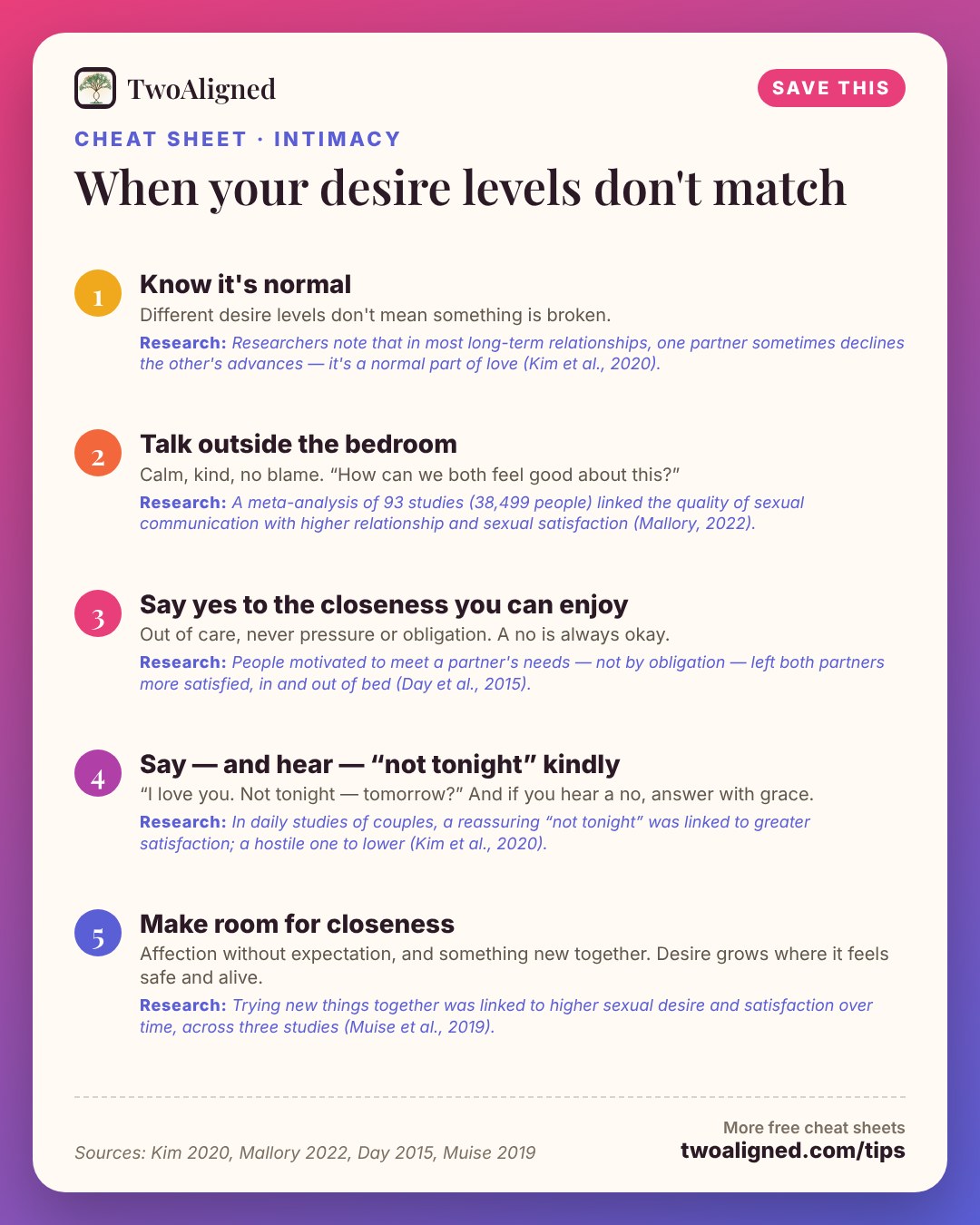
When your desire levels don't match
Almost every long-term couple goes through times when one wants more closeness than the other. It's common — and it's workable when you both come at it with care.
- 1
Know it's normal
Different desire levels don't mean something is broken.
ResearchResearchers note that in most long-term relationships, one partner sometimes declines the other's advances — it's a normal part of love (Kim et al., 2020).
- 2
Talk outside the bedroom
Calm, kind, no blame. “How can we both feel good about this?”
ResearchA meta-analysis of 93 studies (38,499 people) linked the quality of sexual communication with higher relationship and sexual satisfaction (Mallory, 2022).
- 3
Say yes to the closeness you can enjoy
Out of care, never pressure or obligation. A no is always okay.
ResearchPeople motivated to meet a partner's needs — not by obligation — left both partners more satisfied, in and out of bed (Day et al., 2015).
- 4
Say — and hear — “not tonight” kindly
“I love you. Not tonight — tomorrow?” And if you hear a no, answer with grace.
ResearchIn daily studies of couples, a reassuring “not tonight” was linked to greater satisfaction; a hostile one to lower (Kim et al., 2020).
- 5
Make room for closeness
Affection without expectation, and something new together. Desire grows where it feels safe and alive.
ResearchTrying new things together was linked to higher sexual desire and satisfaction over time, across three studies (Muise et al., 2019).
Why this works
Research by Lisa Day, Amy Muise, Samantha Joel and Emily Impett found that when the less-interested partner is motivated by care for the other — not by fear or obligation — both partners feel more satisfied with their sex life and their relationship. Differences in desire don't automatically harm a couple's happiness.
Sources
- All the research behind TwoAligned
- Kim, Muise, Sakaluk, Rosen & Impett (2020), Personality and Social Psychology Bulletin — sexual rejection behaviors
- Mallory (2022), Journal of Family Psychology — sexual communication meta-analysis
- Day, Muise, Joel & Impett (2015), Personality and Social Psychology Bulletin — sexual communal strength
- Muise et al. (2019), Journal of Personality and Social Psychology — self-expanding activities and desire
- University of Toronto — differing desire in long-term relationships
- Mallory, Stanton & Handy (2019) — sexual communication meta-analysis (PsyPost)
- Kim, Muise & Impett (2018) — saying no kindly vs. reluctant sex (PsyPost)
- Kim et al. (2021) — reassuring ways of saying 'not tonight' (PsyPost)
- Debrot et al. — partner touch and well-being (PsyPost)
These are the general steps. Want advice for your situation?
Take the free 2-minute quiz for a first read on what's really going on between you two.
Take the free quiz →