Cheat sheet · Mental load
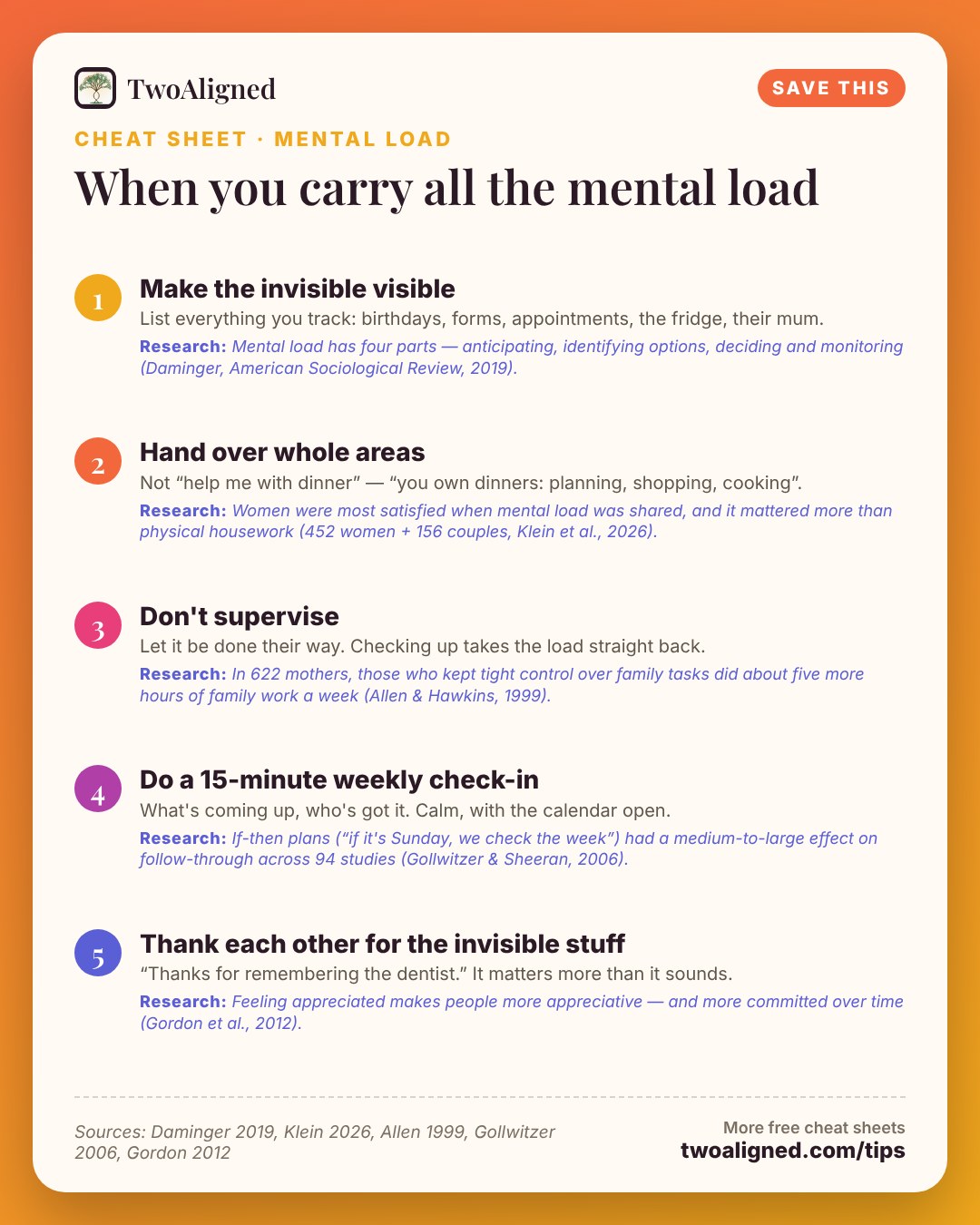
When you carry all the mental load
It's not just doing the chores — it's remembering, planning and noticing everything. That invisible work wears a relationship down quietly. Here's how to share it.
- 1
Make the invisible visible
List everything you track: birthdays, forms, appointments, the fridge, their mum.
ResearchMental load has four parts — anticipating, identifying options, deciding and monitoring (Daminger, American Sociological Review, 2019).
- 2
Hand over whole areas
Not “help me with dinner” — “you own dinners: planning, shopping, cooking”.
ResearchWomen were most satisfied when mental load was shared, and it mattered more than physical housework (452 women + 156 couples, Klein et al., 2026).
- 3
Don't supervise
Let it be done their way. Checking up takes the load straight back.
ResearchIn 622 mothers, those who kept tight control over family tasks did about five more hours of family work a week (Allen & Hawkins, 1999).
- 4
Do a 15-minute weekly check-in
What's coming up, who's got it. Calm, with the calendar open.
ResearchIf-then plans (“if it's Sunday, we check the week”) had a medium-to-large effect on follow-through across 94 studies (Gollwitzer & Sheeran, 2006).
- 5
Thank each other for the invisible stuff
“Thanks for remembering the dentist.” It matters more than it sounds.
ResearchFeeling appreciated makes people more appreciative — and more committed over time (Gordon et al., 2012).
Why this works
A 2026 study of 452 women and 156 couples in the UK and US (Klein, Ascigil, Oschatz & Kahalon) found that how the mental load was shared mattered more for women's relationship satisfaction than how the physical housework was shared. Women were most satisfied when the relationship mental load was split evenly.
Sources
- All the research behind TwoAligned
- Daminger (2019), American Sociological Review — the cognitive dimension of household labor
- Klein et al. (2026), Personality and Social Psychology Bulletin — mental load and satisfaction
- Allen & Hawkins (1999), Journal of Marriage and the Family — maternal gatekeeping
- Gollwitzer & Sheeran (2006), Advances in Experimental Social Psychology — implementation intentions meta-analysis (NCI summary)
- Gordon et al. (2012), Journal of Personality and Social Psychology — gratitude and relationship maintenance
- PsyPost — the invisible chore that may matter more than housework
- Klein et al. (2026) — Personality and Social Psychology Bulletin
- Gordon et al. (2012) — gratitude promotes relationship maintenance
These are the general steps. Want advice for your situation?
Take the free 2-minute quiz for a first read on what's really going on between you two.
Take the free quiz →