Cheat sheet · Trust & intimacy
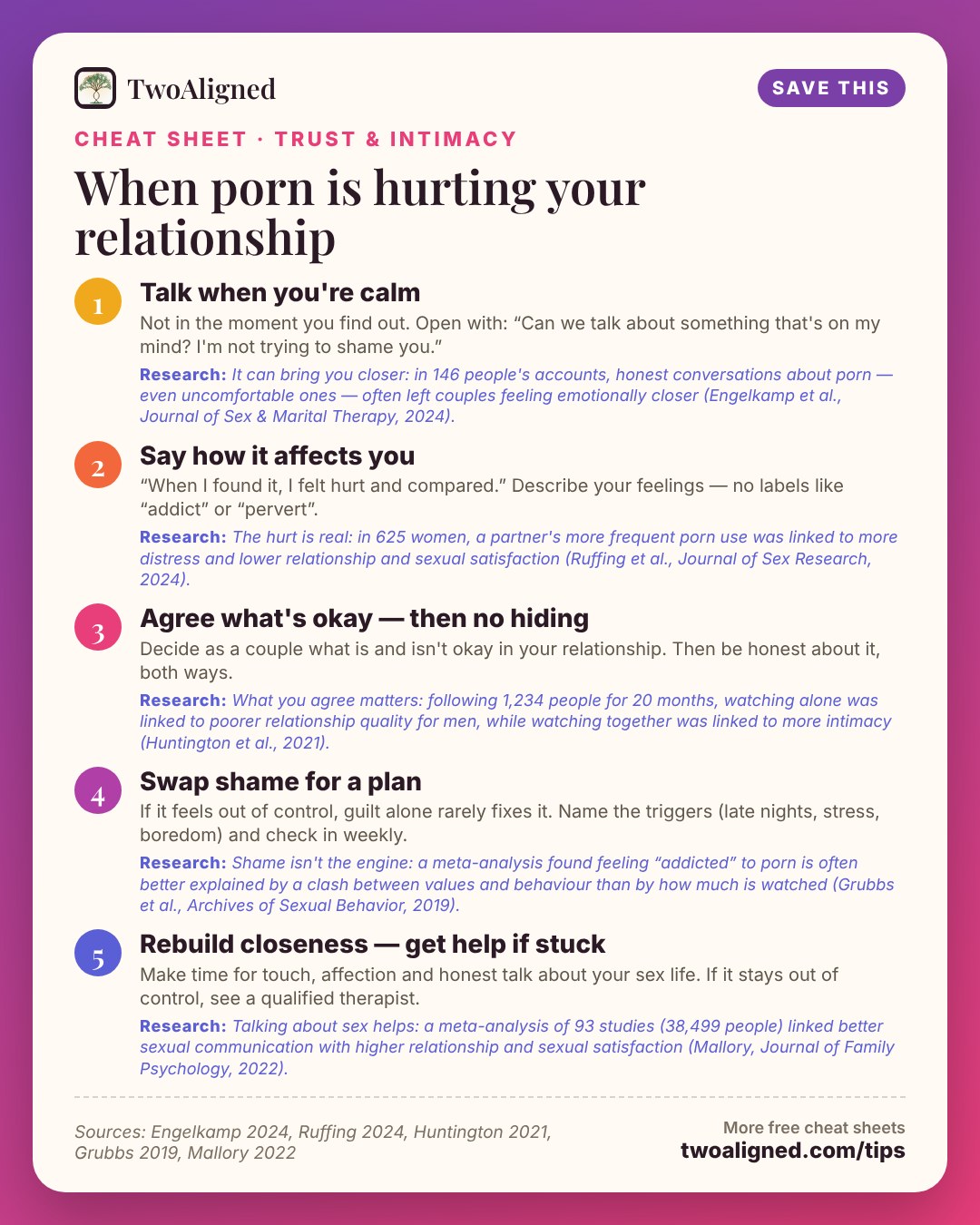
When porn is hurting your relationship
Porn can quietly bring hurt, secrecy and distance into a relationship. Whether you're the one who feels hurt or the one who watches, these steps help you talk about it without shame — and decide together what's okay for the two of you.
- 1
Talk when you're calm
Not in the moment you find out. Open with: “Can we talk about something that's on my mind? I'm not trying to shame you.”
ResearchIt can bring you closer: in 146 people's accounts, honest conversations about porn — even uncomfortable ones — often left couples feeling emotionally closer (Engelkamp et al., Journal of Sex & Marital Therapy, 2024).
- 2
Say how it affects you
“When I found it, I felt hurt and compared.” Describe your feelings — no labels like “addict” or “pervert”.
ResearchThe hurt is real: in 625 women, a partner's more frequent porn use was linked to more distress and lower relationship and sexual satisfaction (Ruffing et al., Journal of Sex Research, 2024).
- 3
Agree what's okay — then no hiding
Decide as a couple what is and isn't okay in your relationship. Then be honest about it, both ways.
ResearchWhat you agree matters: following 1,234 people for 20 months, watching alone was linked to poorer relationship quality for men, while watching together was linked to more intimacy (Huntington et al., 2021).
- 4
Swap shame for a plan
If it feels out of control, guilt alone rarely fixes it. Name the triggers (late nights, stress, boredom) and check in weekly.
ResearchShame isn't the engine: a meta-analysis found feeling “addicted” to porn is often better explained by a clash between values and behaviour than by how much is watched (Grubbs et al., Archives of Sexual Behavior, 2019).
- 5
Rebuild closeness — get help if stuck
Make time for touch, affection and honest talk about your sex life. If it stays out of control, see a qualified therapist.
ResearchTalking about sex helps: a meta-analysis of 93 studies (38,499 people) linked better sexual communication with higher relationship and sexual satisfaction (Mallory, Journal of Family Psychology, 2022).
Why this works
A meta-analysis of 50 studies (about 50,000 people) linked pornography use with lower relationship and sexual satisfaction for men; for women the link was not significant (Wright et al., Human Communication Research, 2017). It is a link, not proof of cause — an unhappy relationship can also lead to more porn use. That's why these steps focus on honesty and reconnection, not blame.
If erection problems are part of the worry, see a doctor first: in a large survey of men, how often they watched porn had weak or no link to erectile problems, which usually have common health causes (Rowland et al., International Journal of Impotence Research, 2023).
Sources
- All the research behind TwoAligned
- Engelkamp et al. (2024), Journal of Sex & Marital Therapy — couples' conversations about pornography
- Ruffing et al. (2024), Journal of Sex Research — women's distress about a partner's pornography use
- Huntington, Markman & Rhoades (2021), Journal of Sex & Marital Therapy — watching alone or together
- Grubbs et al. (2019), Archives of Sexual Behavior — moral incongruence meta-analysis
- Mallory (2022), Journal of Family Psychology — sexual communication meta-analysis
- Wright et al. (2017), Human Communication Research — pornography and satisfaction meta-analysis
- Rowland et al. (2023), International Journal of Impotence Research — pornography, masturbation and erectile function
- Willoughby & Leonhardt (2020), Journal of Sex Research — individual and joint pornography use in couples
These are the general steps. Want advice for your situation?
Take the free 2-minute quiz for a first read on what's really going on between you two.
Take the free quiz →