Cheat sheet · Blended families
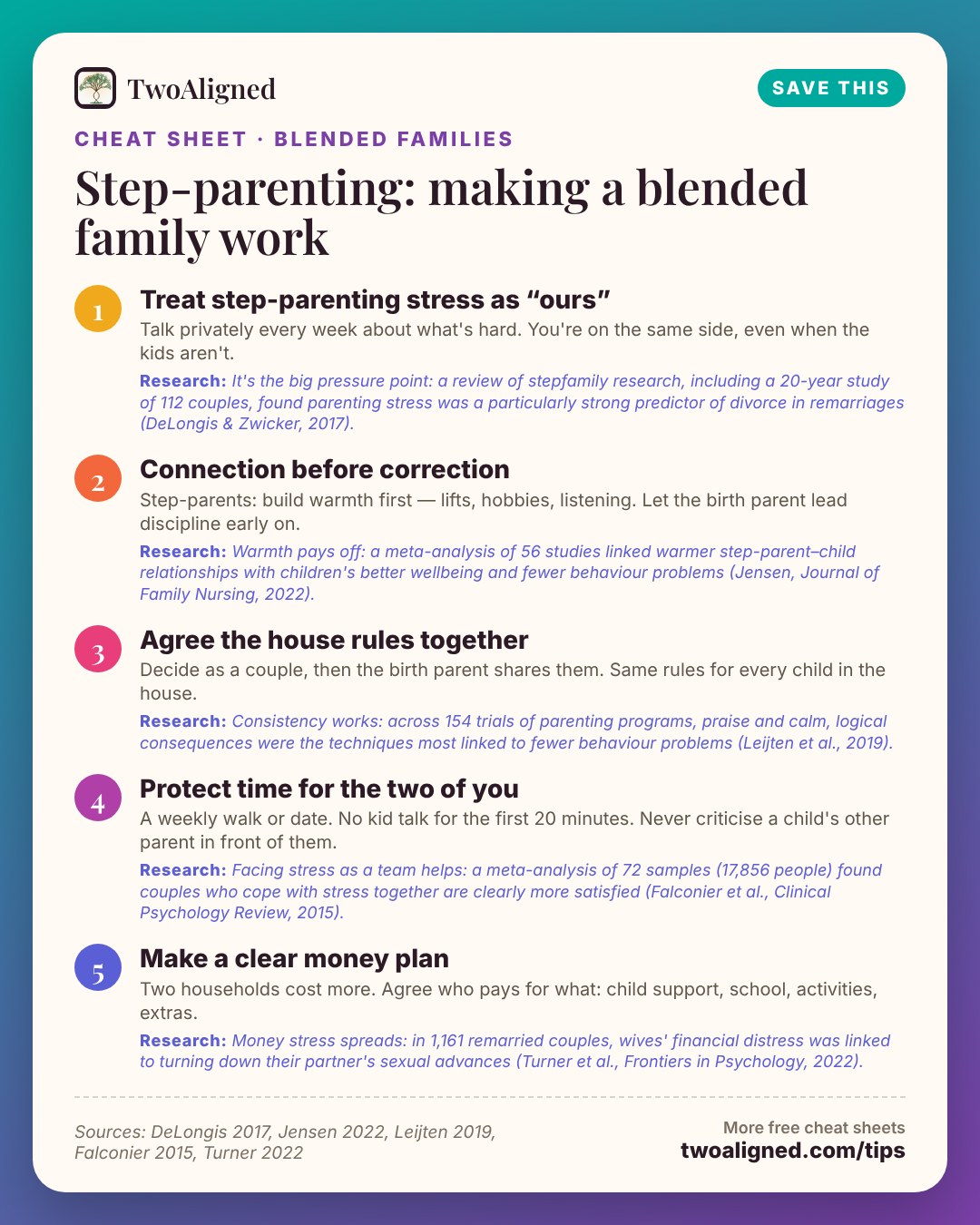
Step-parenting: making a blended family work
Blended families come with built-in pressure: new roles, old loyalties, an ex in the picture and kids who didn't choose any of it. These steps protect your relationship and the children.
- 1
Treat step-parenting stress as “ours”
Talk privately every week about what's hard. You're on the same side, even when the kids aren't.
ResearchIt's the big pressure point: a review of stepfamily research, including a 20-year study of 112 couples, found parenting stress was a particularly strong predictor of divorce in remarriages (DeLongis & Zwicker, 2017).
- 2
Connection before correction
Step-parents: build warmth first — lifts, hobbies, listening. Let the birth parent lead discipline early on.
ResearchWarmth pays off: a meta-analysis of 56 studies linked warmer step-parent–child relationships with children's better wellbeing and fewer behaviour problems (Jensen, Journal of Family Nursing, 2022).
- 3
Agree the house rules together
Decide as a couple, then the birth parent shares them. Same rules for every child in the house.
ResearchConsistency works: across 154 trials of parenting programs, praise and calm, logical consequences were the techniques most linked to fewer behaviour problems (Leijten et al., 2019).
- 4
Protect time for the two of you
A weekly walk or date. No kid talk for the first 20 minutes. Never criticise a child's other parent in front of them.
ResearchFacing stress as a team helps: a meta-analysis of 72 samples (17,856 people) found couples who cope with stress together are clearly more satisfied (Falconier et al., Clinical Psychology Review, 2015).
- 5
Make a clear money plan
Two households cost more. Agree who pays for what: child support, school, activities, extras.
ResearchMoney stress spreads: in 1,161 remarried couples, wives' financial distress was linked to turning down their partner's sexual advances (Turner et al., Frontiers in Psychology, 2022).
Why this works
Second marriages face pressures first marriages don't. A review of stepfamily research found that stress about parenting is one of the strongest predictors of divorce in remarriages (DeLongis & Zwicker, Current Opinion in Psychology, 2017) — which is why the couple has to handle it as a team.
Children do better when the step-parent relationship is warm: across 56 studies, warmer step-parent–child relationships went with better wellbeing and school results and fewer behaviour problems (Jensen, 2022). Warmth first makes rules easier later.
Sources
- All the research behind TwoAligned
- DeLongis & Zwicker (2017), Current Opinion in Psychology — marital satisfaction and divorce in stepfamilies
- Jensen (2022), Journal of Family Nursing — step-parent–child relationships meta-analysis
- Leijten et al. (2019), Journal of the American Academy of Child & Adolescent Psychiatry — key parenting program components
- Falconier et al. (2015), Clinical Psychology Review — dyadic coping meta-analysis
- Turner et al. (2022), Frontiers in Psychology — economic distress and intimacy in remarriage
These are the general steps. Want advice for your situation?
Take the free 2-minute quiz for a first read on what's really going on between you two.
Take the free quiz →